AIR Nests
Nestwork
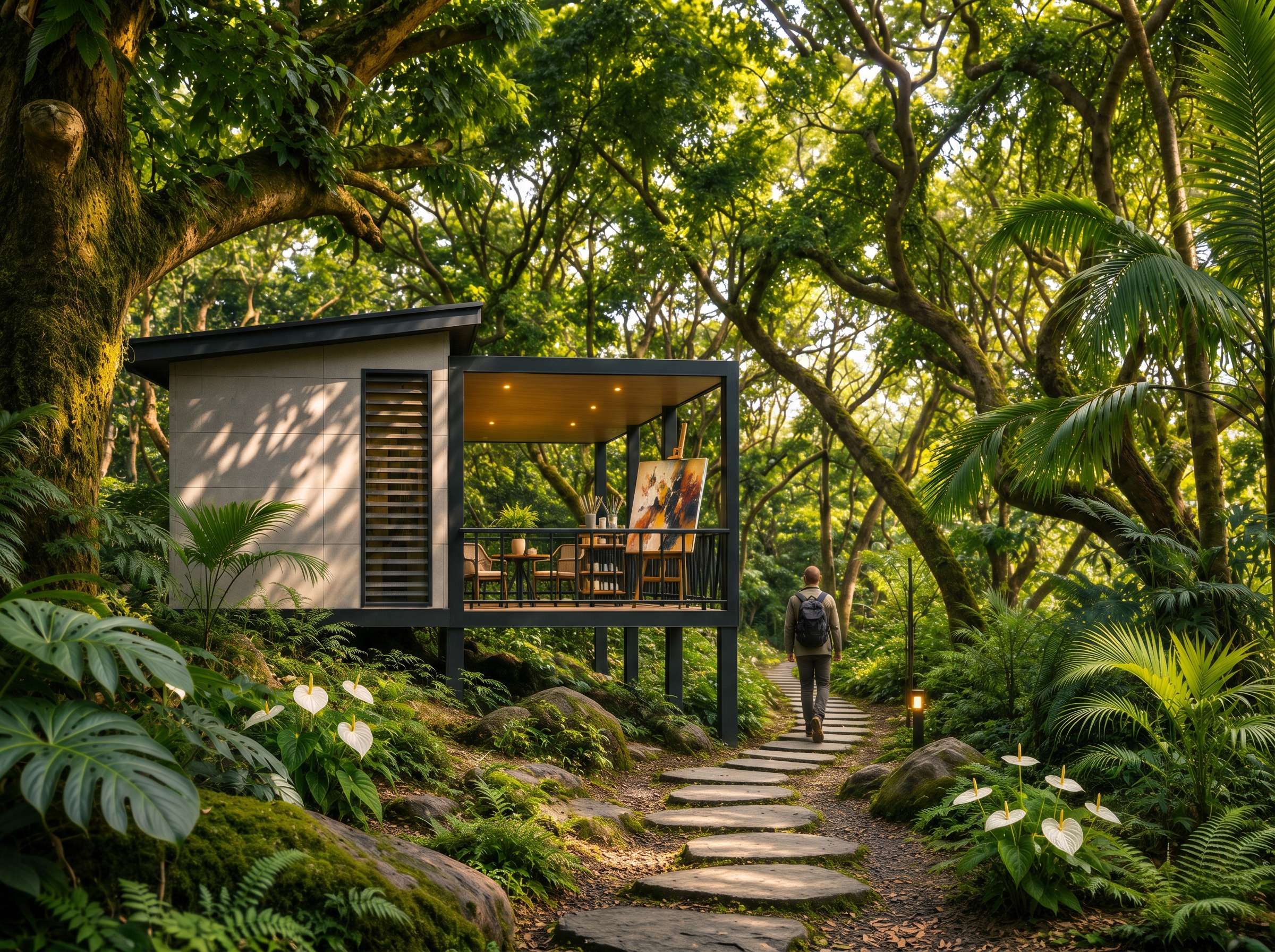
Twelve modular dwellings for artists and travellers, set on pads in a former orchard at Deep River.
- Project
- Artistic Immersive Retreat (AIR)
- Location
- Deep River, Flacq, Mauritius
- Programme
- Stays, artist residencies, workshops, exhibitions
- Architecture
- Divyaa Hauzaree
- Permits
- Harikesh Sunkur, consulting architect
- Manufacturer
- Housinnovation
- Land
- Ten-year renewable lease granted by Alteo
- Show Nest
- Installation early 2027
- Document
- Investor brochure, version 1.2, 1 November 2026
At a glance
The project on one page
Three reasons to believe
- A venue already open
- AIR’s gallery and garden welcome the public every day: the Nests rest on an ecosystem that already exists, not on a promise.
- Full management
- AIR markets, hosts and maintains; the owner receives 70% of rental revenue without having to handle it.
- An asset of your own
- Movable property, fully owned, resaleable, relocatable, covered by the manufacturer’s ten-year guarantee.
The assumptions are cautious: 30% occupancy, against 54% in the Flacq district. Even at 60 nights a year, the Nest produces net income.
The site stands on land owned by Alteo, a Mauritian group listed on the Stock Exchange of Mauritius, which leases it under a ten-year renewable lease.
The place
An art venue inland
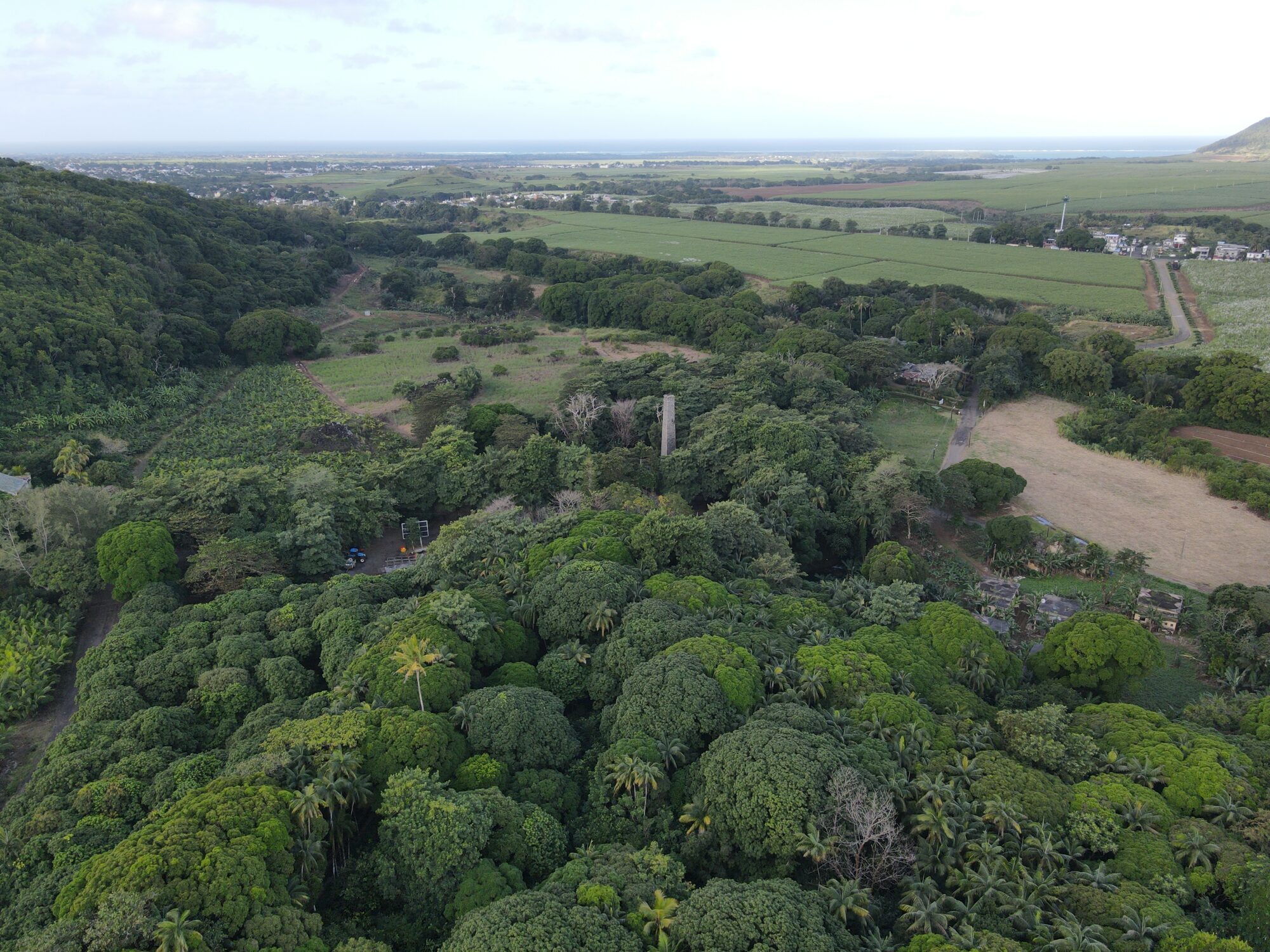
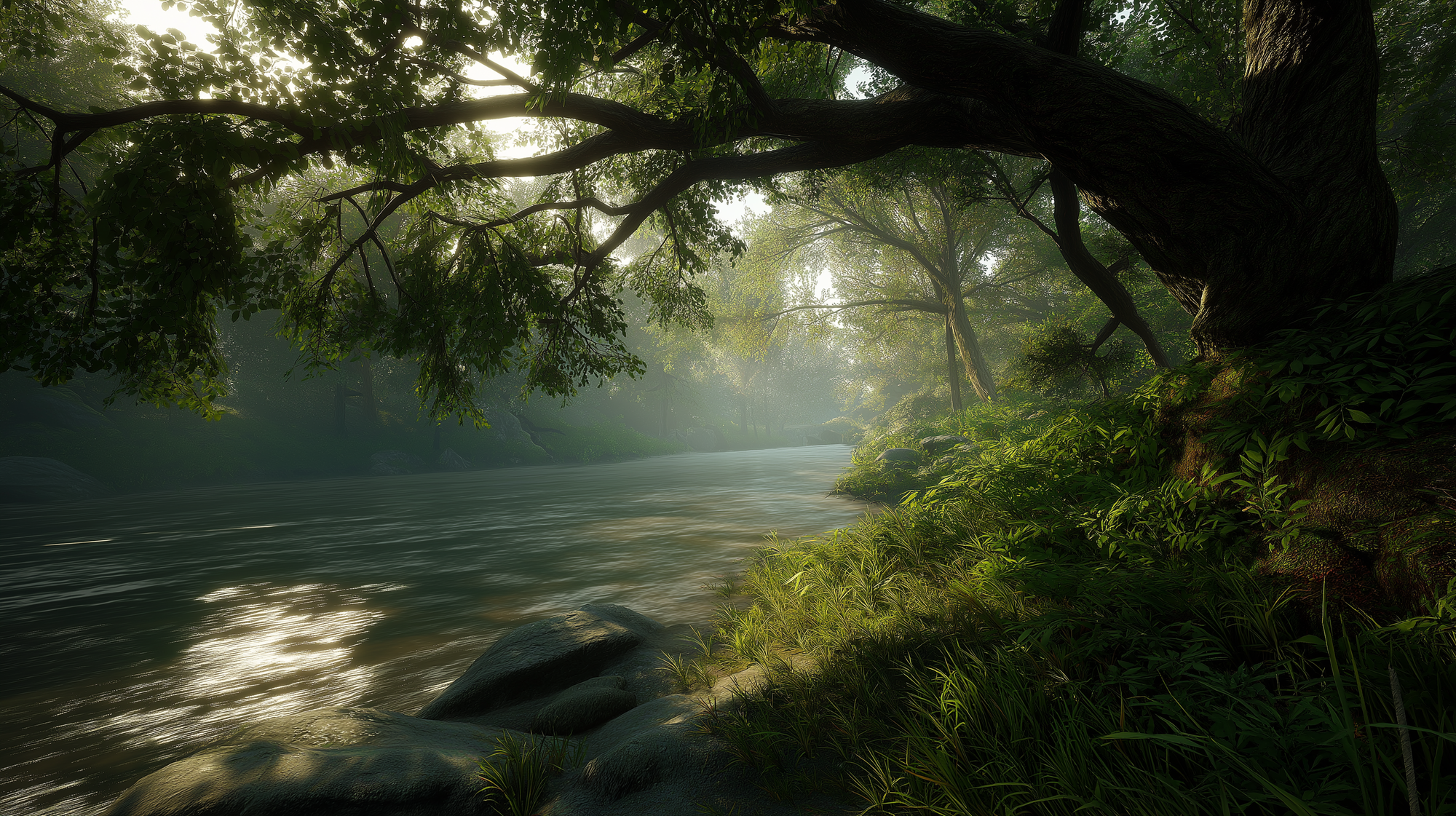
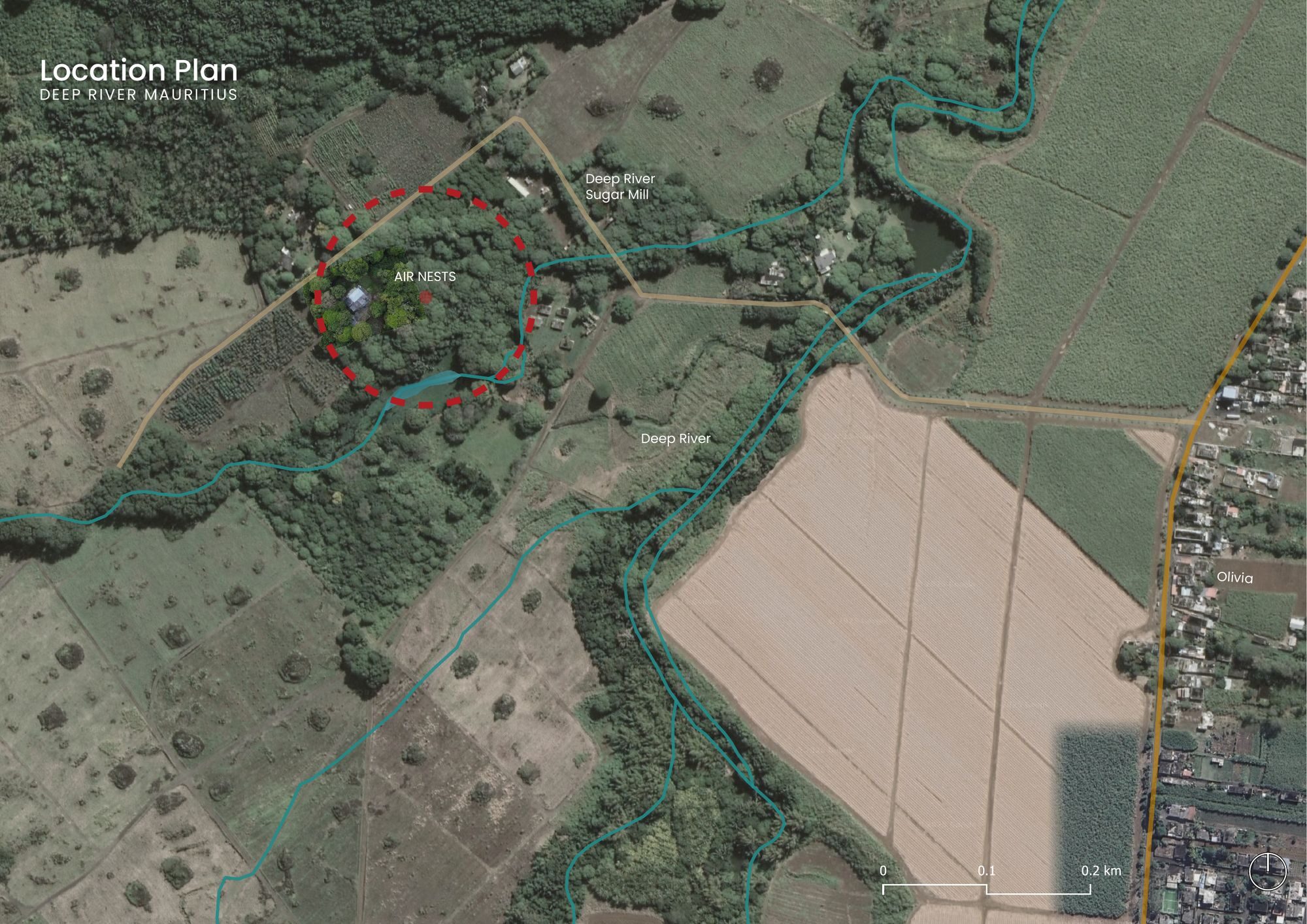
Deep River is a valley shaped by water, away from the coast: riverbanks, a former orchard of century-old mango trees, former farm tracks. AIR, Artistic Immersive Retreat, has opened a gallery and garden there; the Nests are the next step, light dwellings in which to stay, work and linger.
The Nests extend Artistic Immersive Retreat, where art, nature and mobility meet; their light architecture takes its meaning from the site itself: the river, the great trees, the slope.
Here, the value of a stay lies in what people do, residencies, exhibitions, workshops, slow hospitality, as much as in the setting.
Vision
Why Deep River, why now
Mauritius now wants tourism that no longer stops at the beach. Deep River, its orchard and its art venue answer that ambition.
The island welcomed 1,436,250 tourists in 2025, up 3.9%1. The Minister of Tourism, Richard Duval, wants to move beyond the beach model toward heritage, nature, ecotourism and the island’s interior; he means to judge growth by its quality rather than by arrival numbers2.
AIR answers it with a hybrid investment, between cultural hospitality and modular real estate, guided by four principles. Mobility: an asset that can evolve, relocate, expand or be upgraded. Culture: every Nest is tied to the residencies and the gallery. Ecology: passive cooling, rainwater, a reduced footprint. Value: rental income backed by an ecosystem rather than a location.
What we want people to live there
MorningThe river before anyone else.
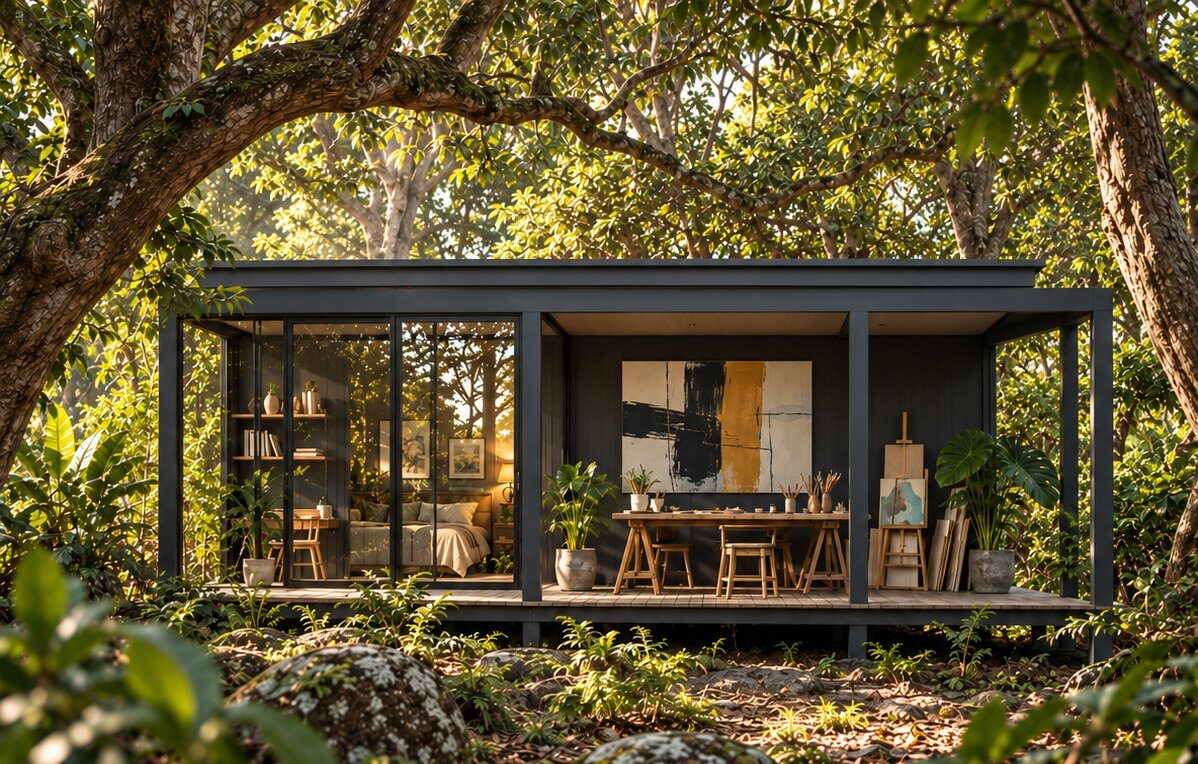
StudioThe veranda open to the mango trees, a canvas in progress.
EncounterAn artist in residence who opens the door in the afternoon.
TableA shared dinner under the century-old tamarind.
CraftAn artisan showing their trade, once a month.
NightA cello on a full-moon evening.
SeasonThe solstice, celebrated in several traditions.
NothingReading, drawing, keeping quiet.
AIR’s visual world sets the tone.
The Nestwork
Linking the Nests without turning the orchard into a road network
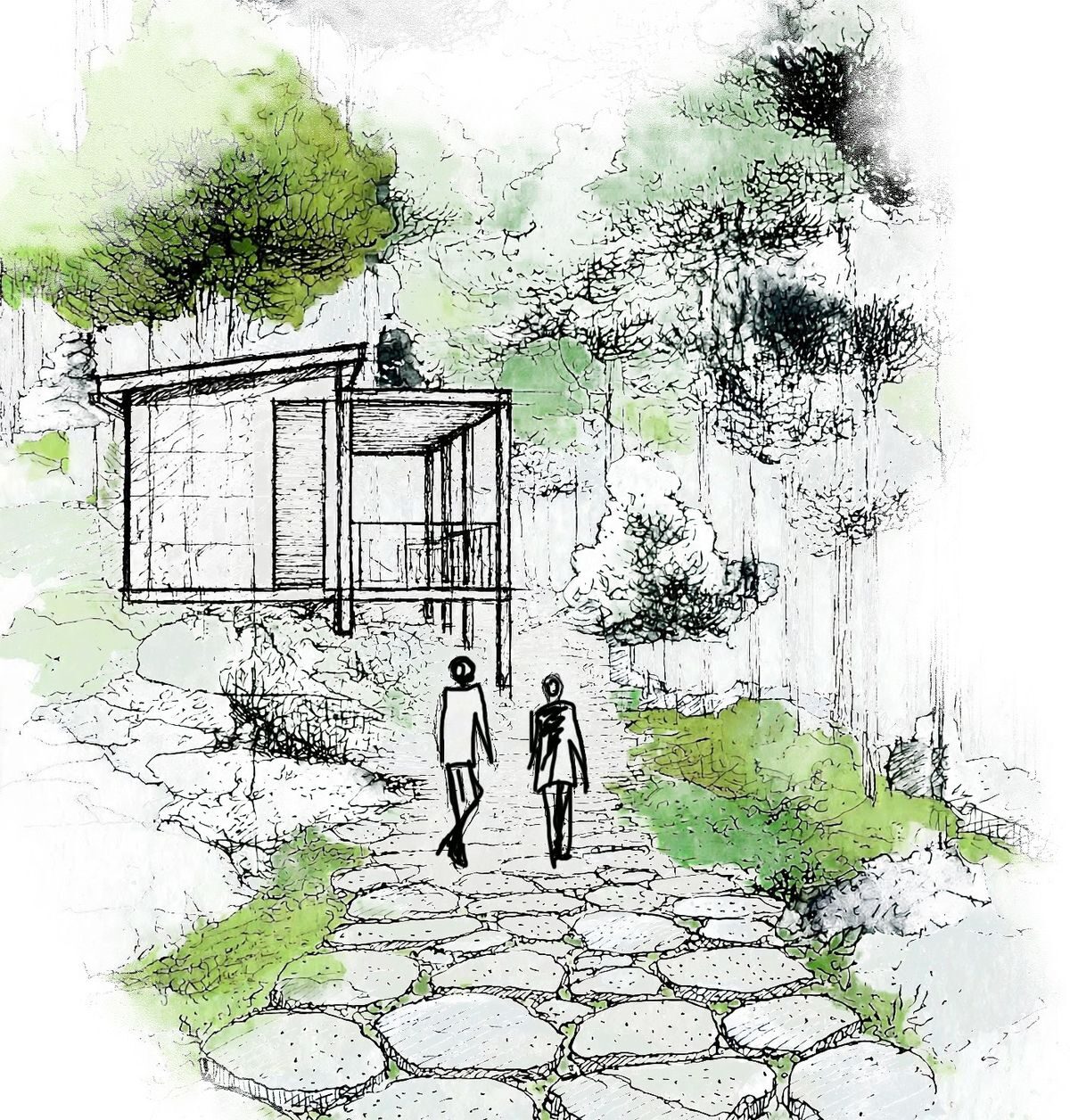
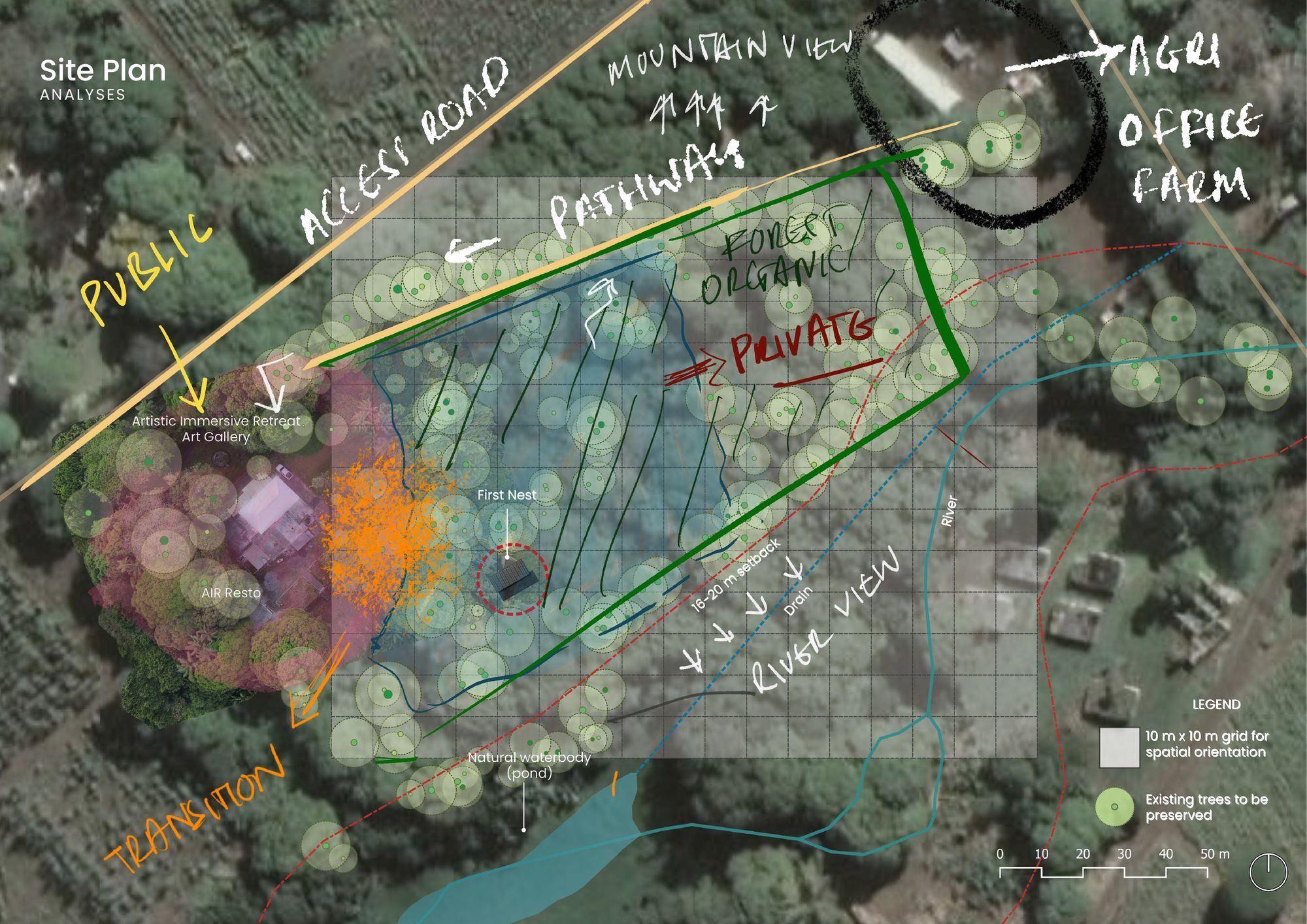
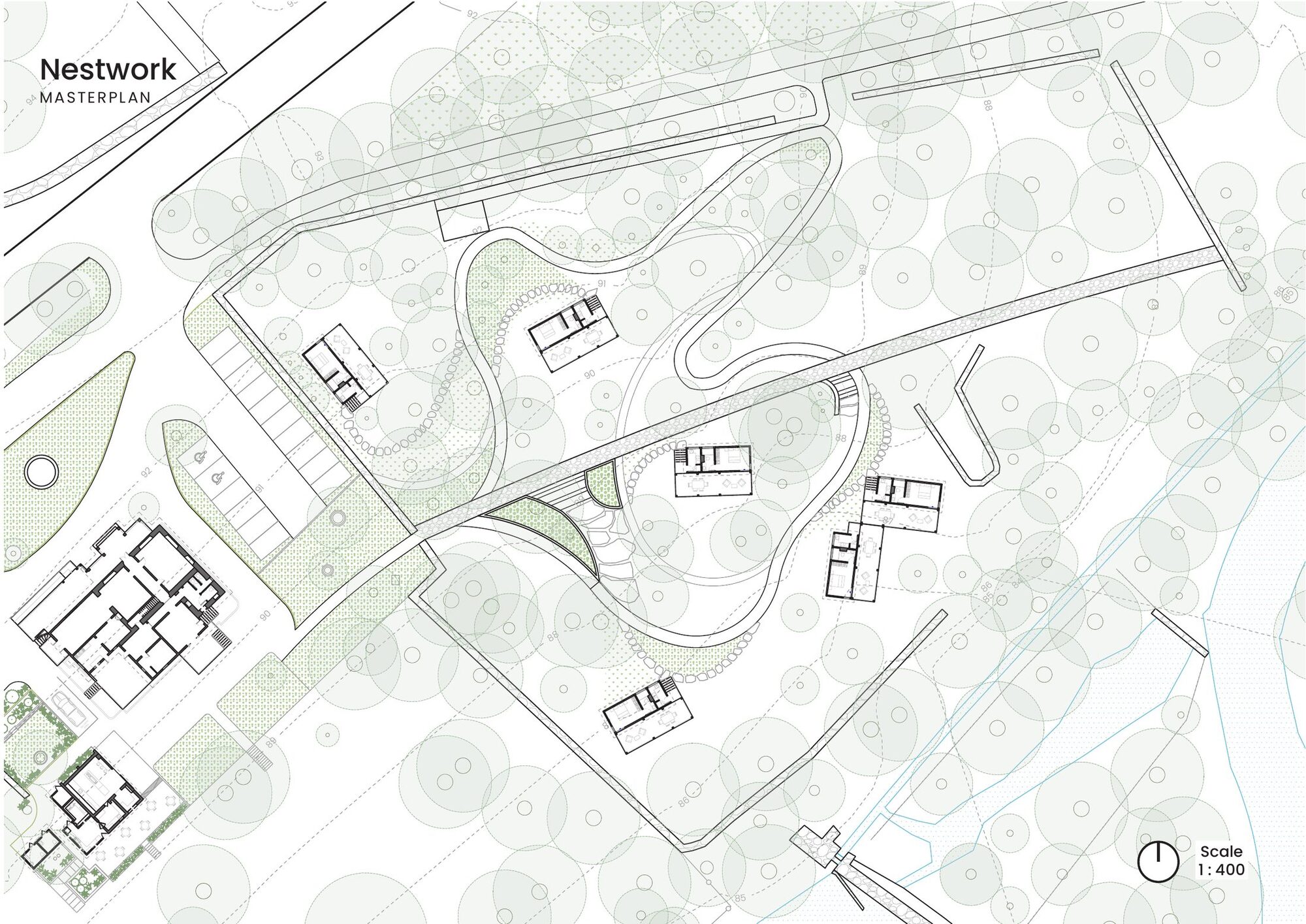
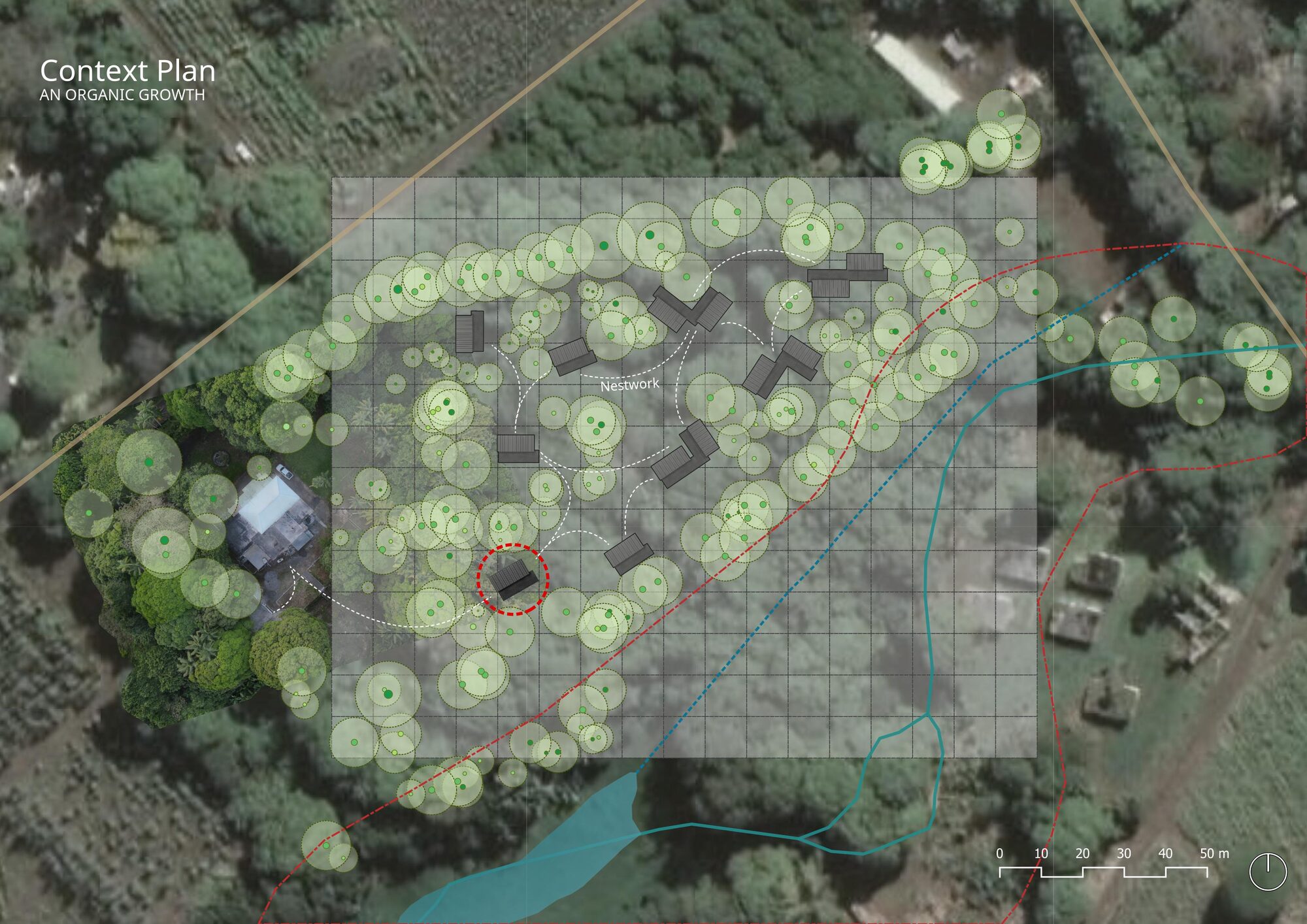
Divyaa Hauzaree approached the site the way one composes a canvas: solids and voids, crossing lines, zones of silence. One question guides the drawing: how can individual residences be connected through a shared landscape while each keeps its autonomy?
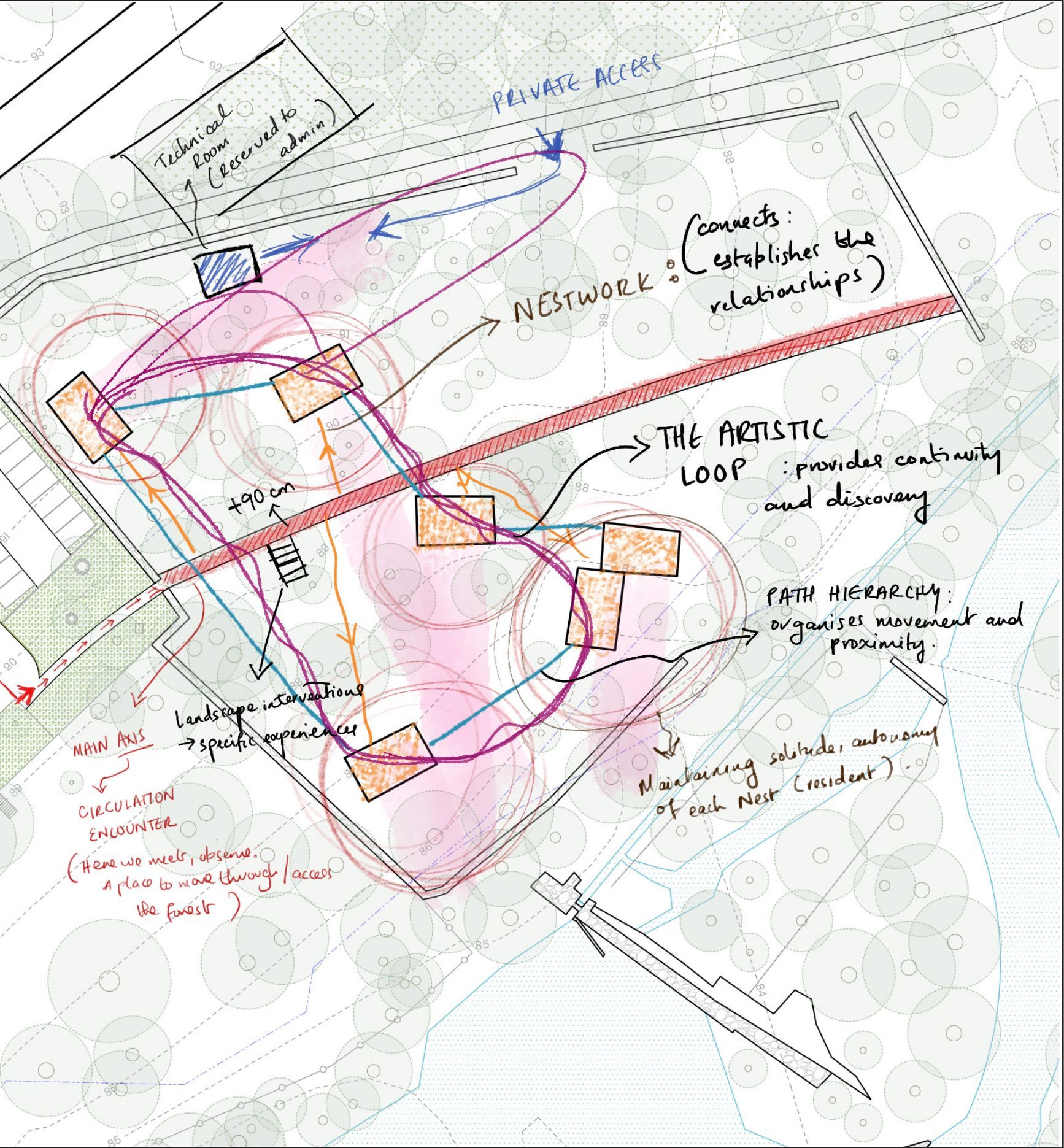
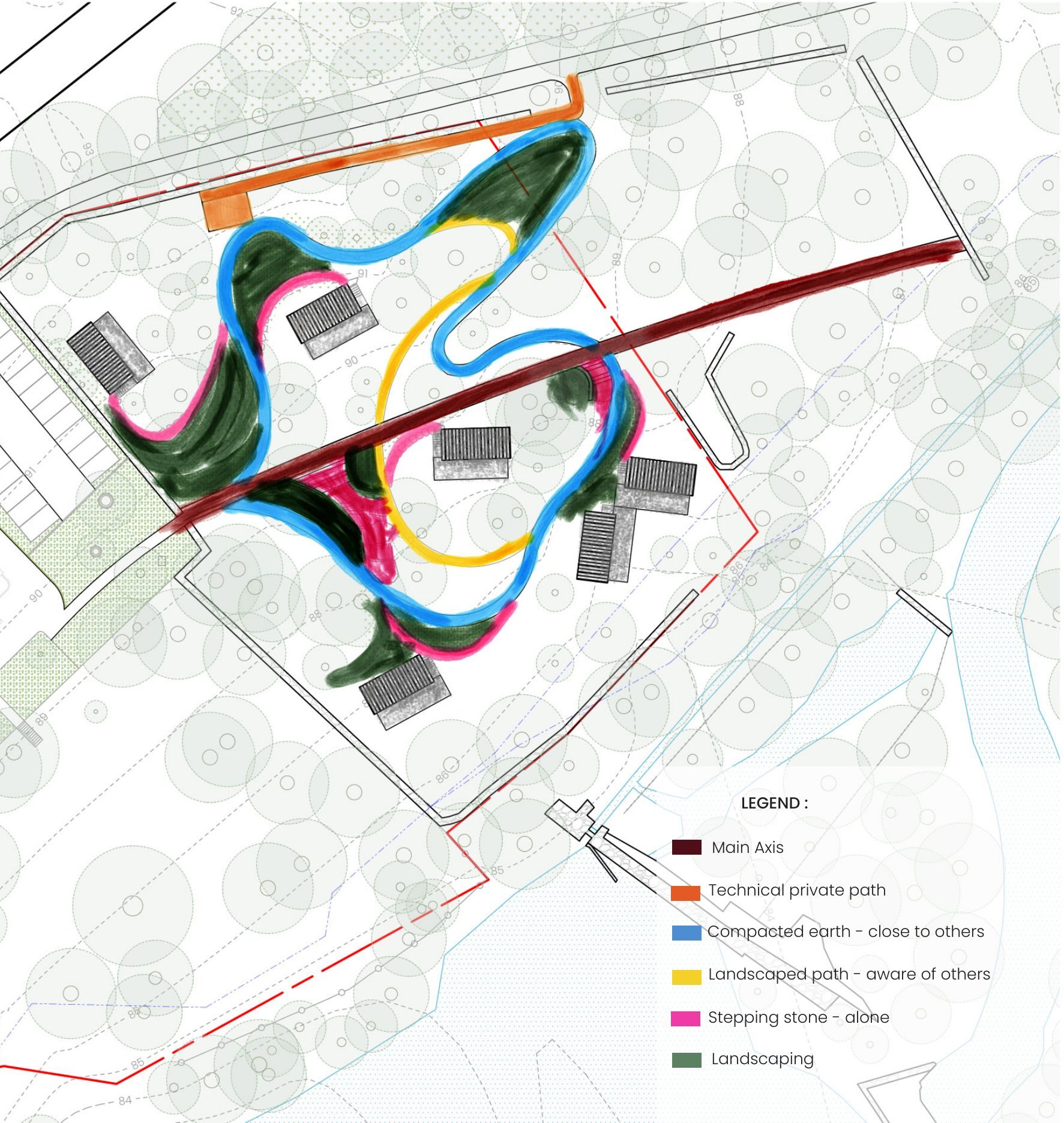
The Nestwork balances connection and solitude, movement and pause, individual practice and collective life. It starts from the existing trees, paths, topography and the relationships between the Nests. The plan below covers the first phase: the show Nest and five others. Six more Nests will then complete the site.
From loop to landscape
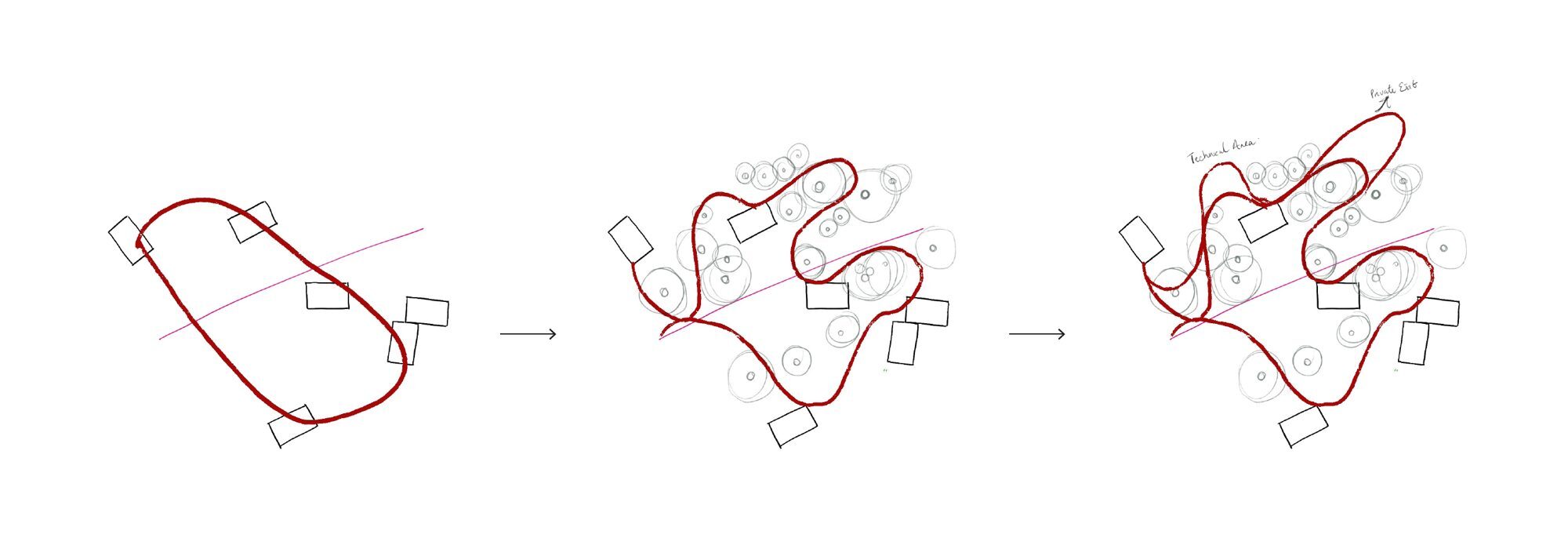
- The loop. A continuous route connects the Nests.
- The network. The loop adapts to the existing trees, residences and site conditions.
- The spatial experiences. Variations, connections and moments of retreat, observation and encounter.
Paths as degrees of intimacy
The network varies in character and in how close it brings people to one another, from shared movement to solitude. Each practice finds its own way into the orchard: the writer seeks silence, the painter light, the sculptor material, the musician acoustics, the photographer framing, the performer movement.
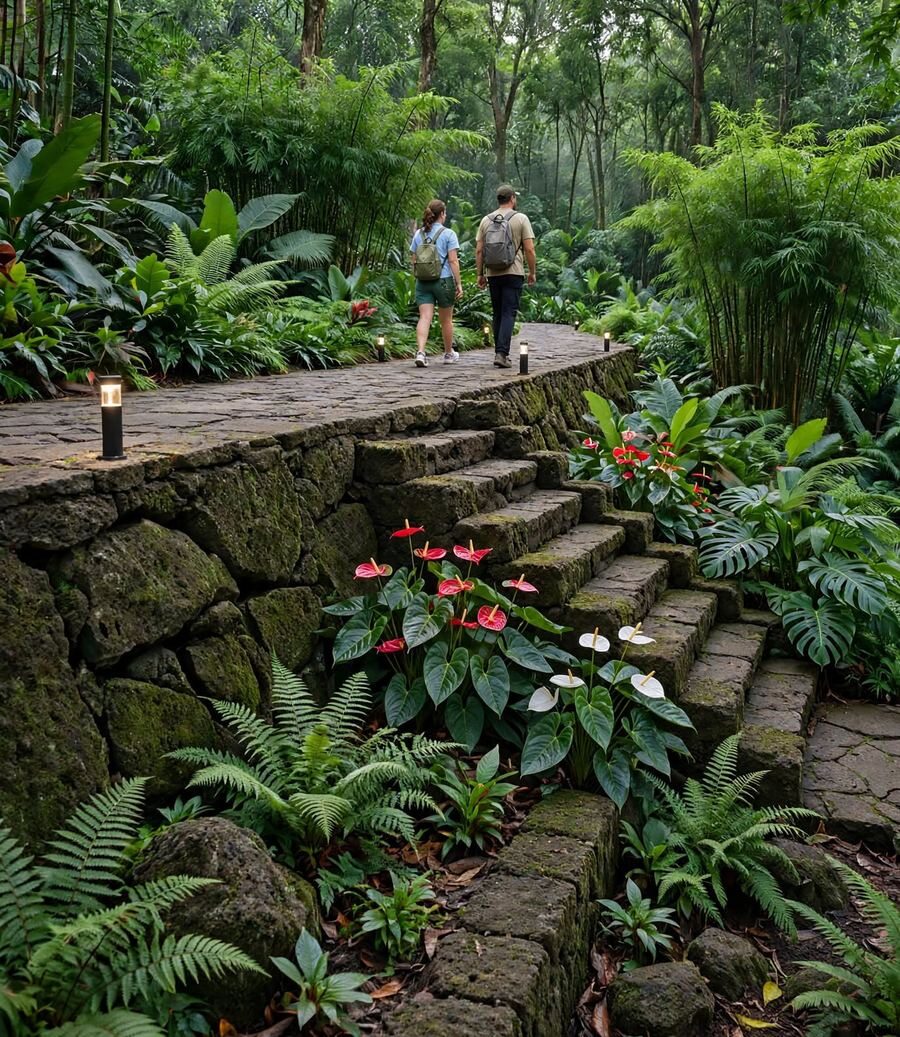
Main axis in volcanic stone
With others
A defined, durable route that gives the site continuity and carries shared movement.
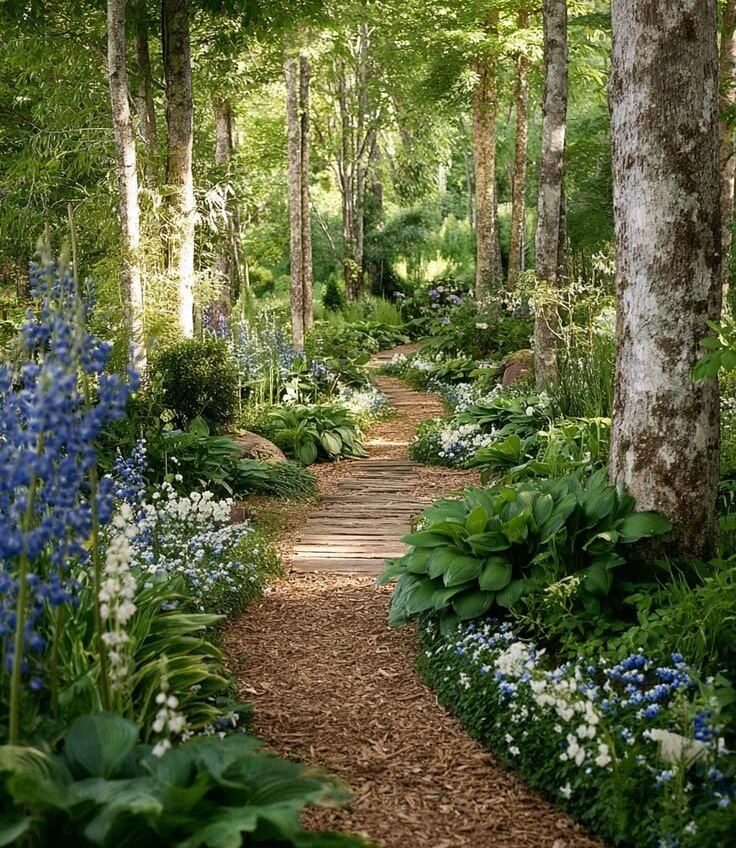
Compacted earth
Close to others
A natural, discreet and economical surface; for paths approaching the Nests and shared edges.
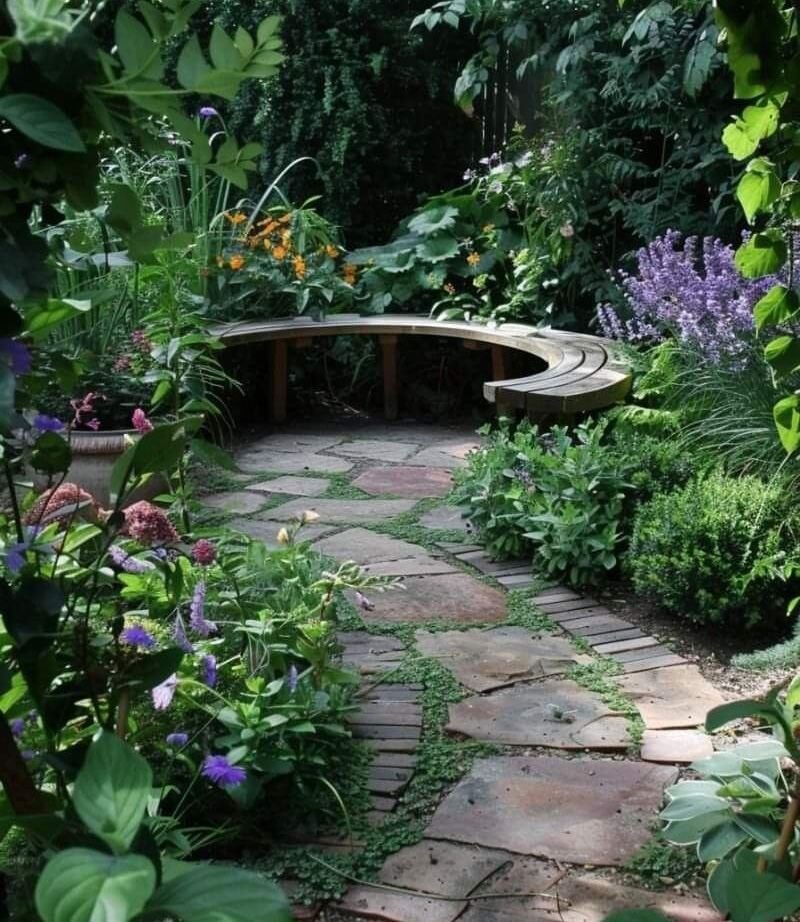
Landscaped path
Aware of others
Thresholds, junctions, seating and outdoor making; residents notice one another without having to engage.
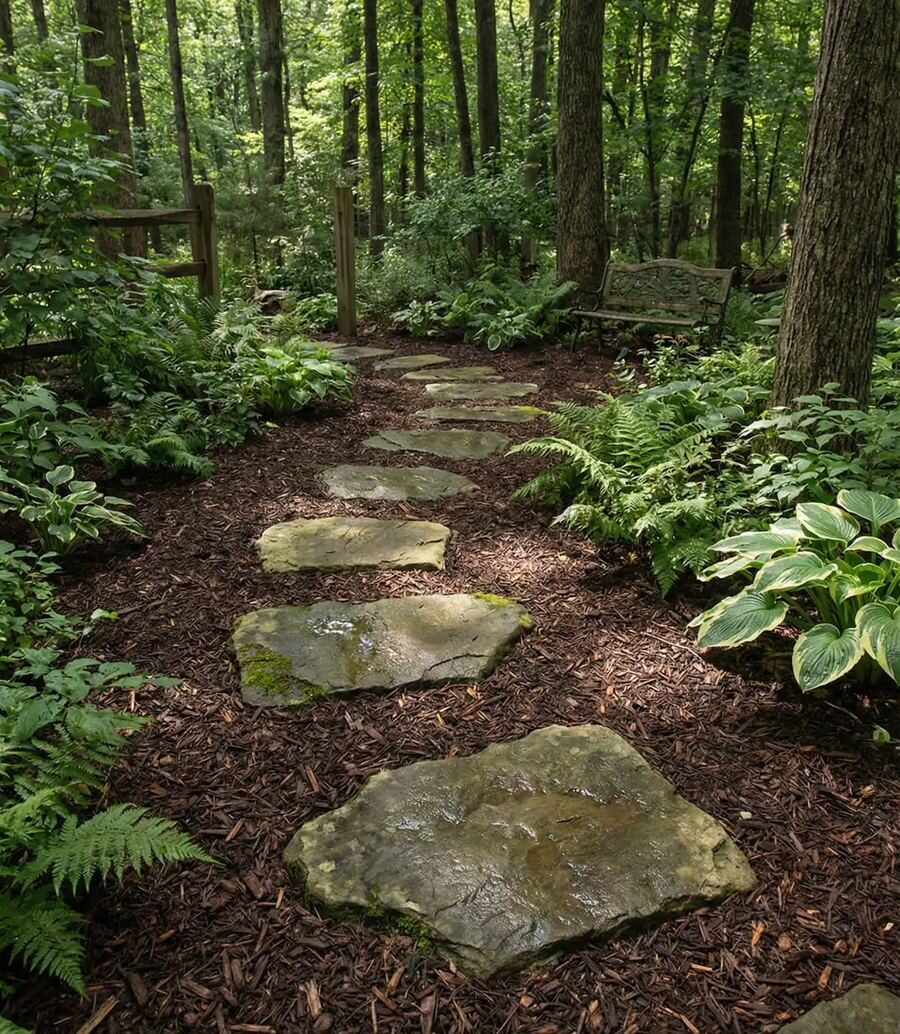
Stepping stones
Alone
Spaced stones that leave the ground visible; for slow routes, viewpoints and contemplation.
referenceMood images chosen by the architect for each type of path.
The Nest
53.3 m² between the bedroom and the canopy
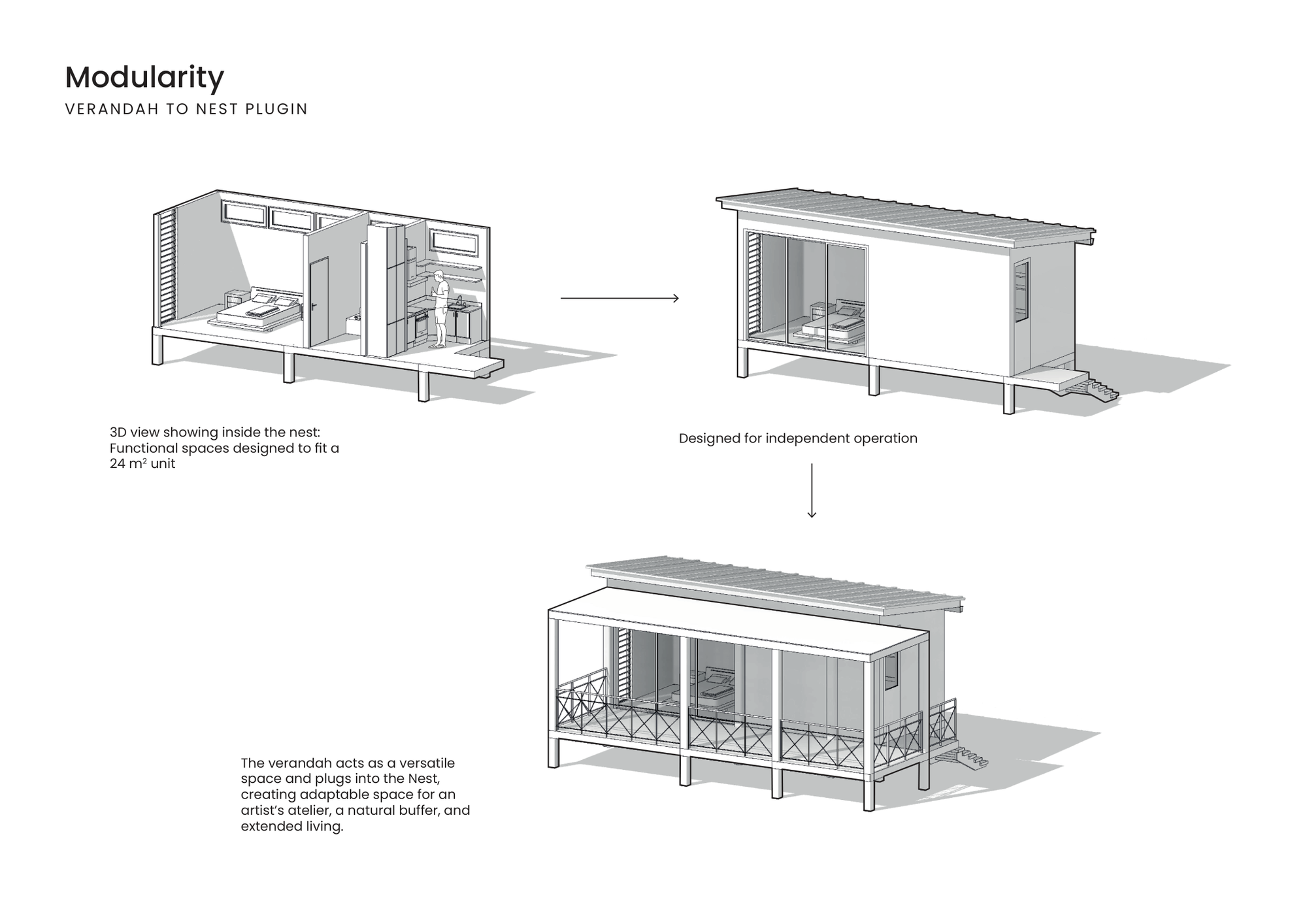
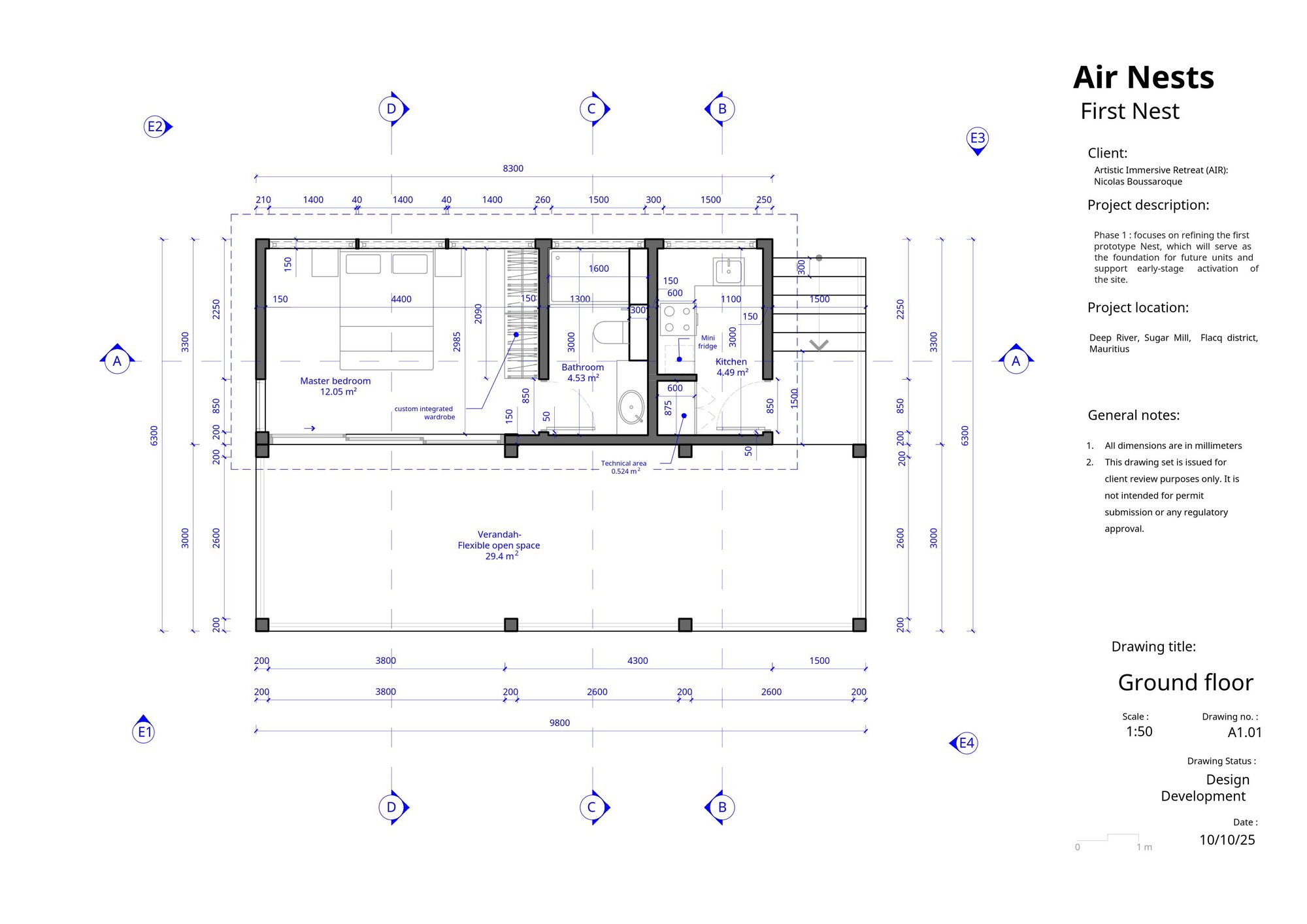
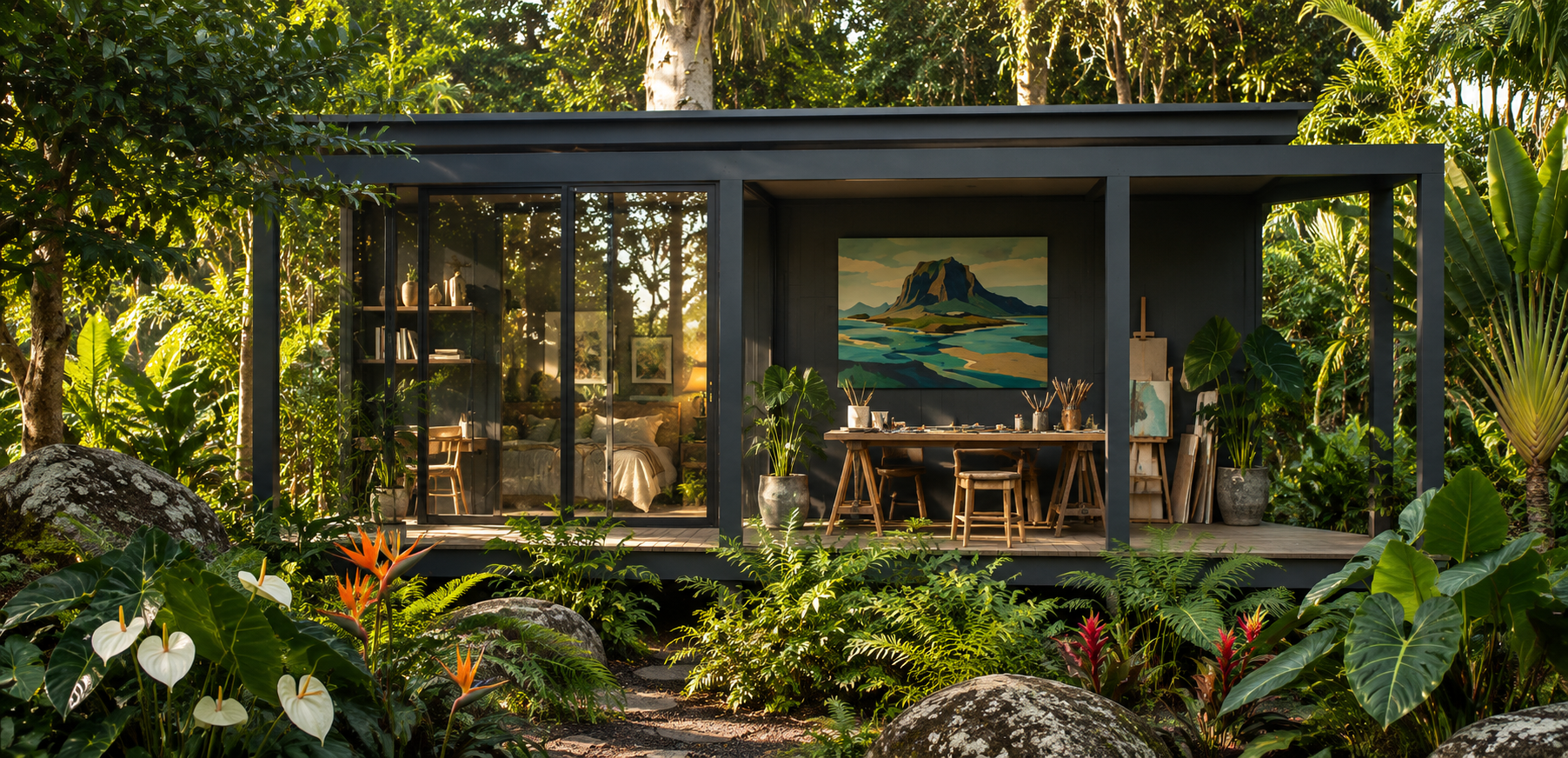
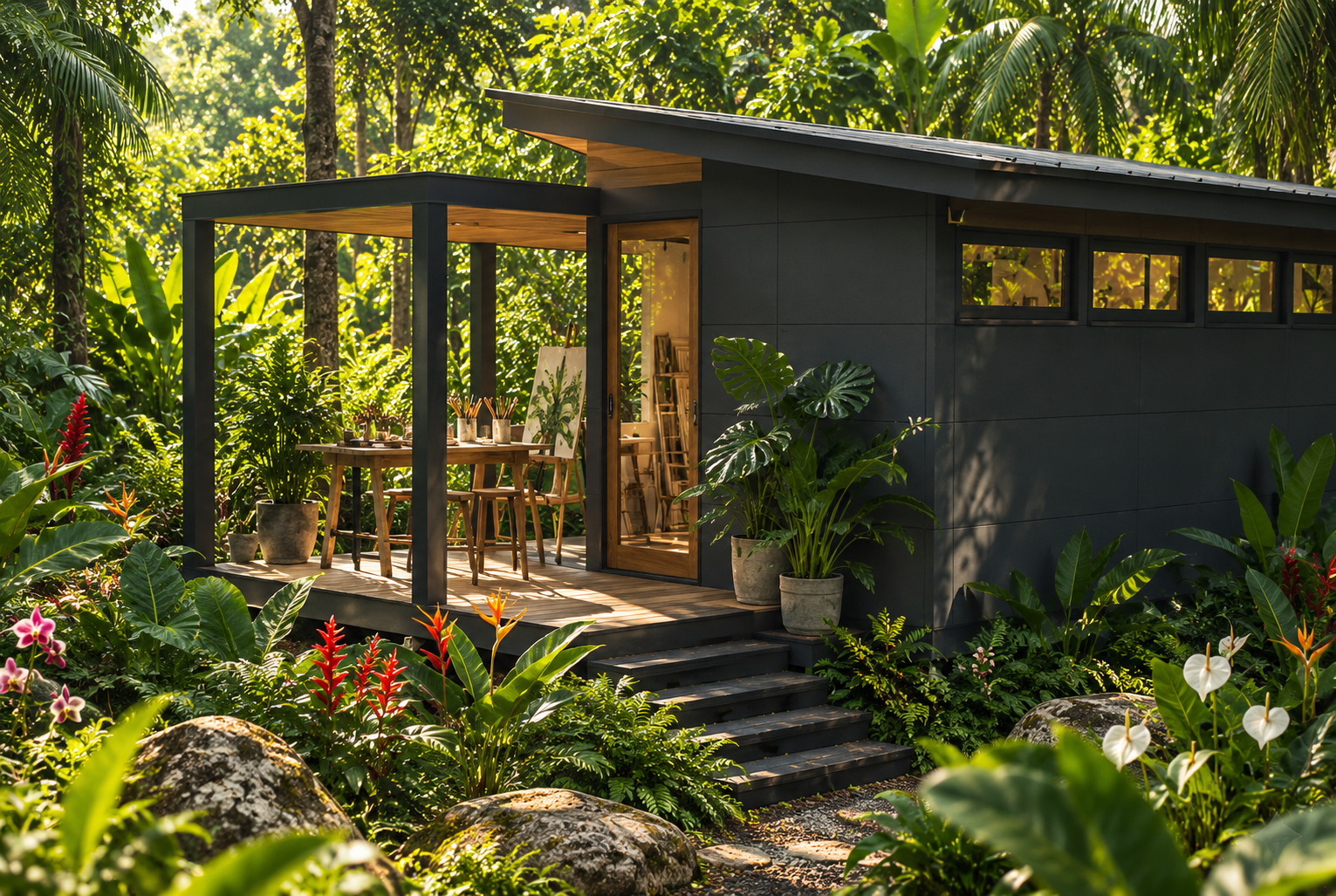
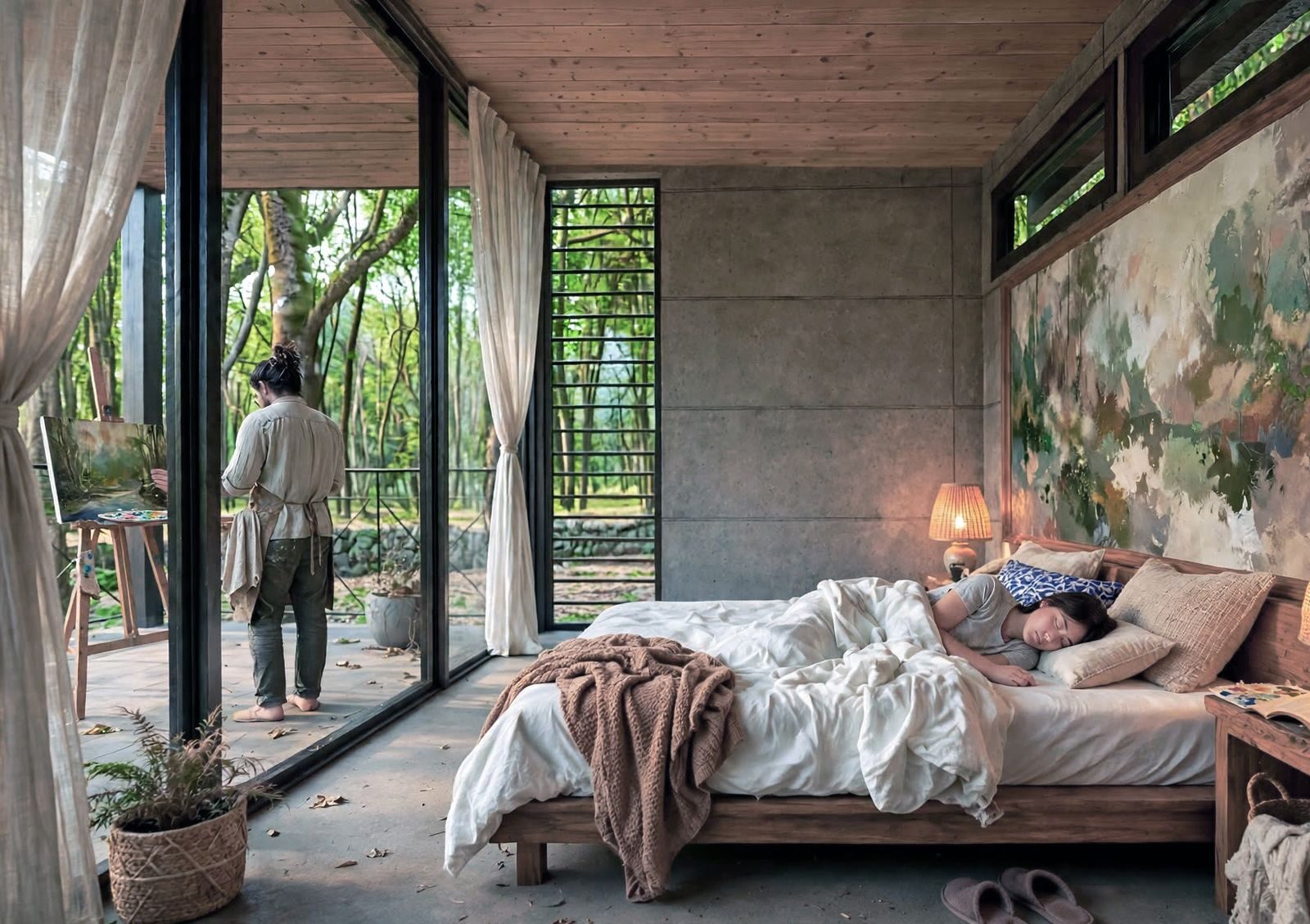
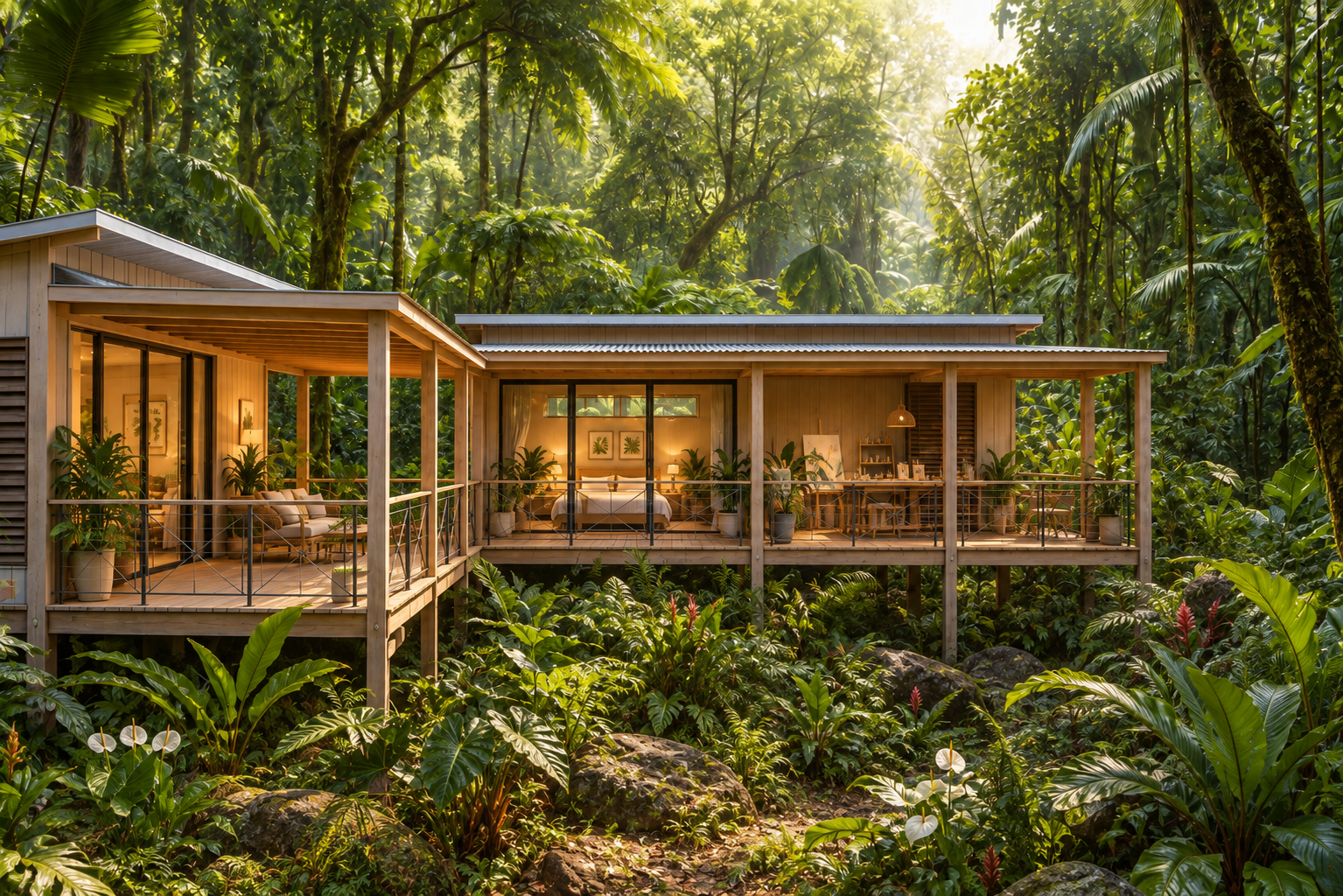
A Nest is first of all a refuge: a place of one’s own, a bedroom that can become a studio, a bathroom, a kitchenette and a large covered veranda open to the orchard. One works there in peace and meets others only when one wishes. Its plans are final: what is shown here is exactly what will be delivered.
Three modules fit together: the Nest, the veranda and the stairs. Together they offer the floor area of a premium hotel suite, with more privacy and a direct relationship with the trees.
| Room | Area | Description |
|---|---|---|
| Bedroom or studio | 12.06 m² | Raised ceiling, orchard view |
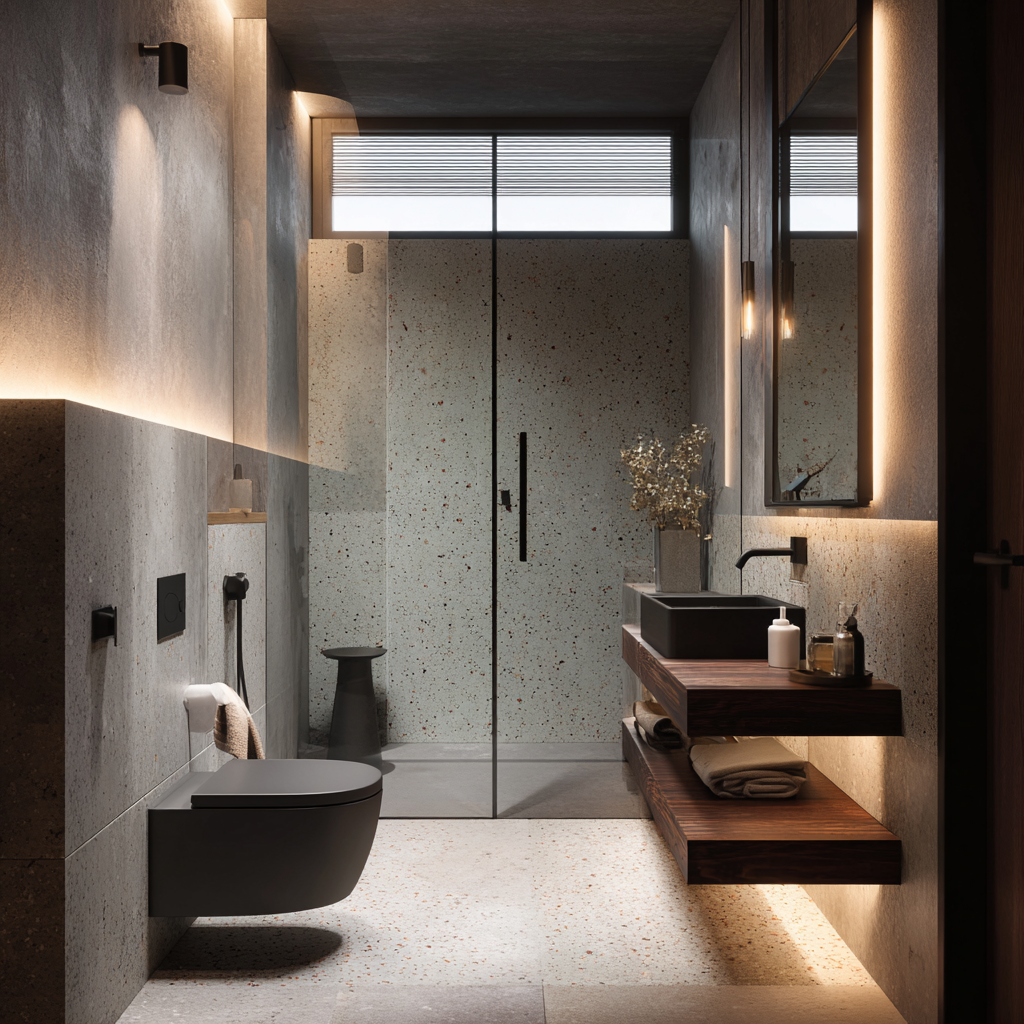
| Bathroom | 4.58 m² | Full-height tiling, walk-in shower, ventilation |
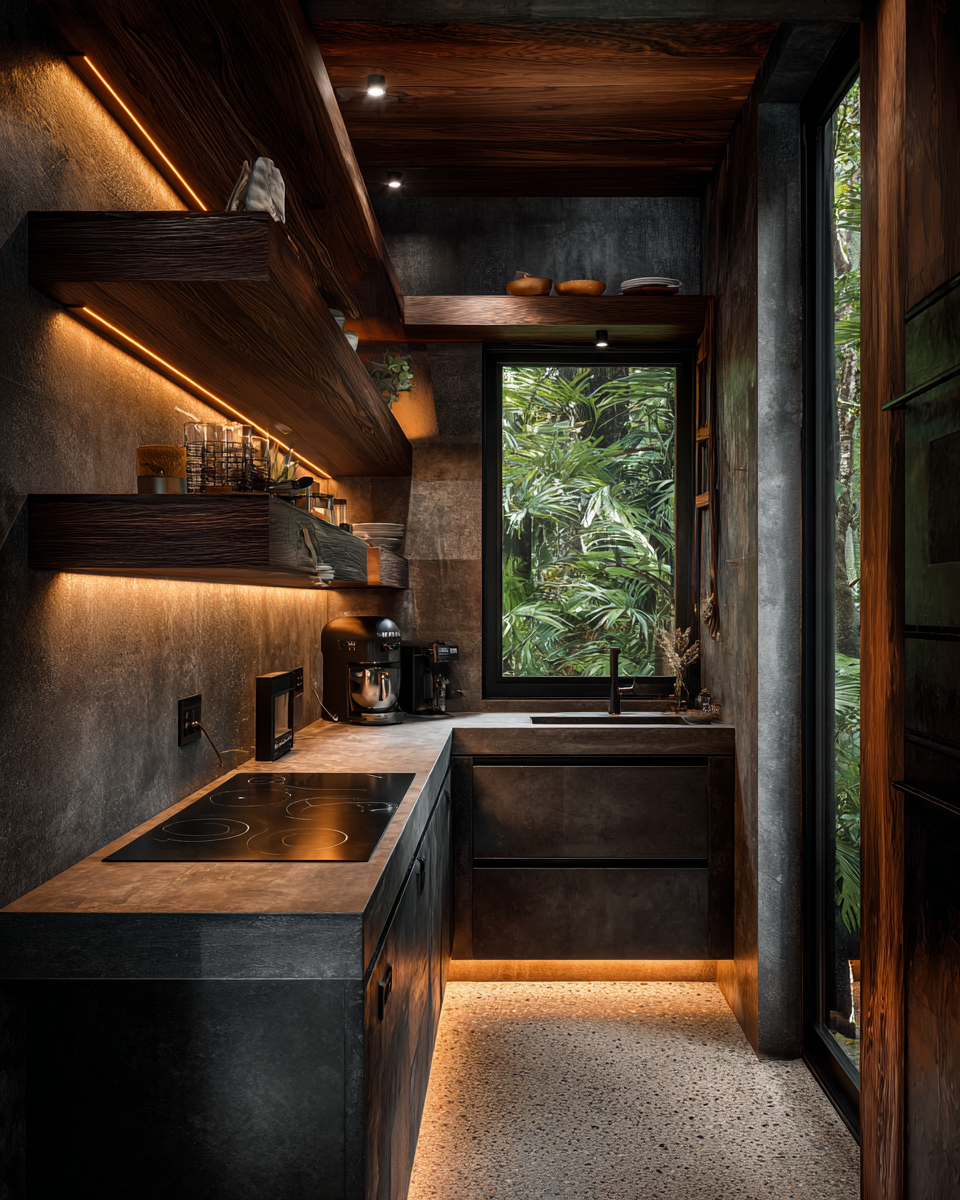
| Kitchenette | 4.48 m² | Compact kitchen, integrated storage |
| Veranda | 28.4 m² | Sheltered studio, dining or work space |
A Nest shaped to a practice
Beyond the standard configuration, optional fit-outs turn the Nest into a working space. Each is designed with Divyaa Hauzaree to preserve the Nest’s architectural integrity.
- Painter’s studio
- Easels, material storage, wash station, enhanced daylight
- Writer’s retreat
- Desk facing the trees, built-in shelving, acoustic treatment, ergonomic seating
- Ceramicist’s workshop
- Reinforced floor, dedicated water and power supply, storage, work surfaces
- Photographer’s gallery
- Hanging systems, lighting rails, portfolio display, equipment storage
- Bespoke
- A solution developed with the architect and the AIR team
Optional fit-outs, priced according to scope and subject to architectural approval.
Construction
Designed for the tropics, built to last
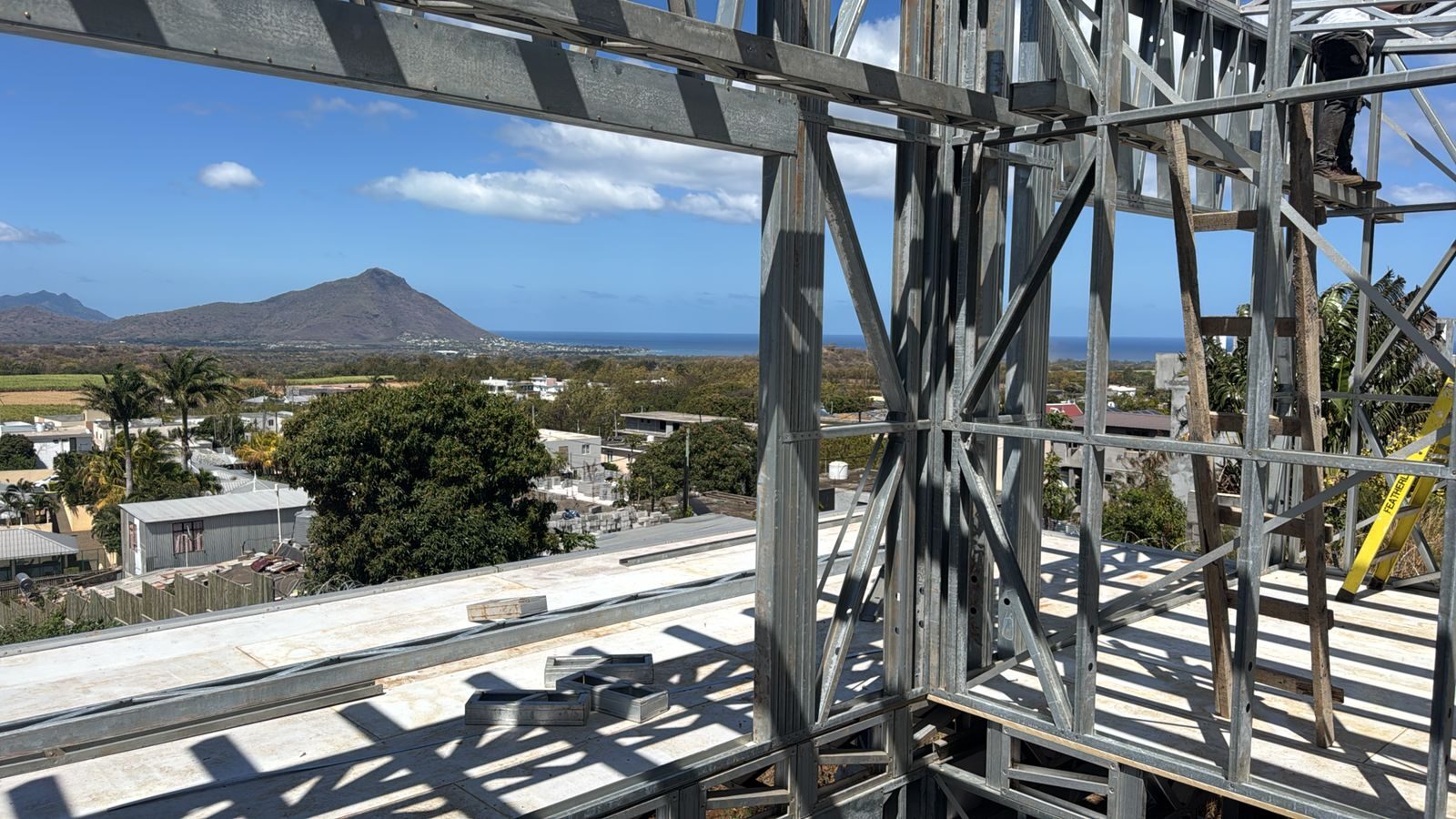
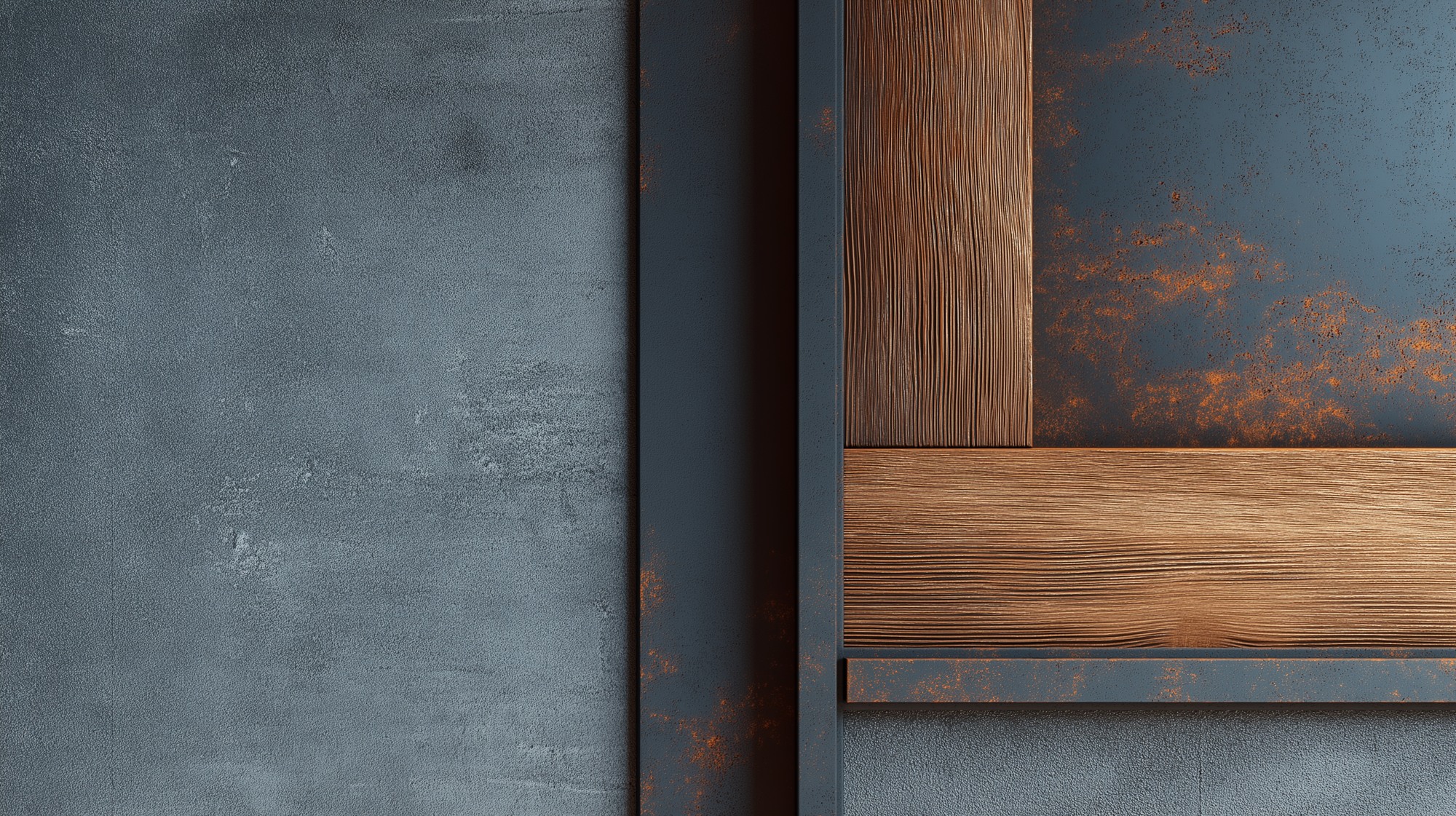
Every element is chosen to withstand cyclones, protect comfort and keep maintenance low; the structure is also covered by the manufacturer’s ten-year guarantee.
- Frame
- 3 mm galvanised steel, rated for cyclonic winds up to 250 km/h; reinforced anchoring
- Walls
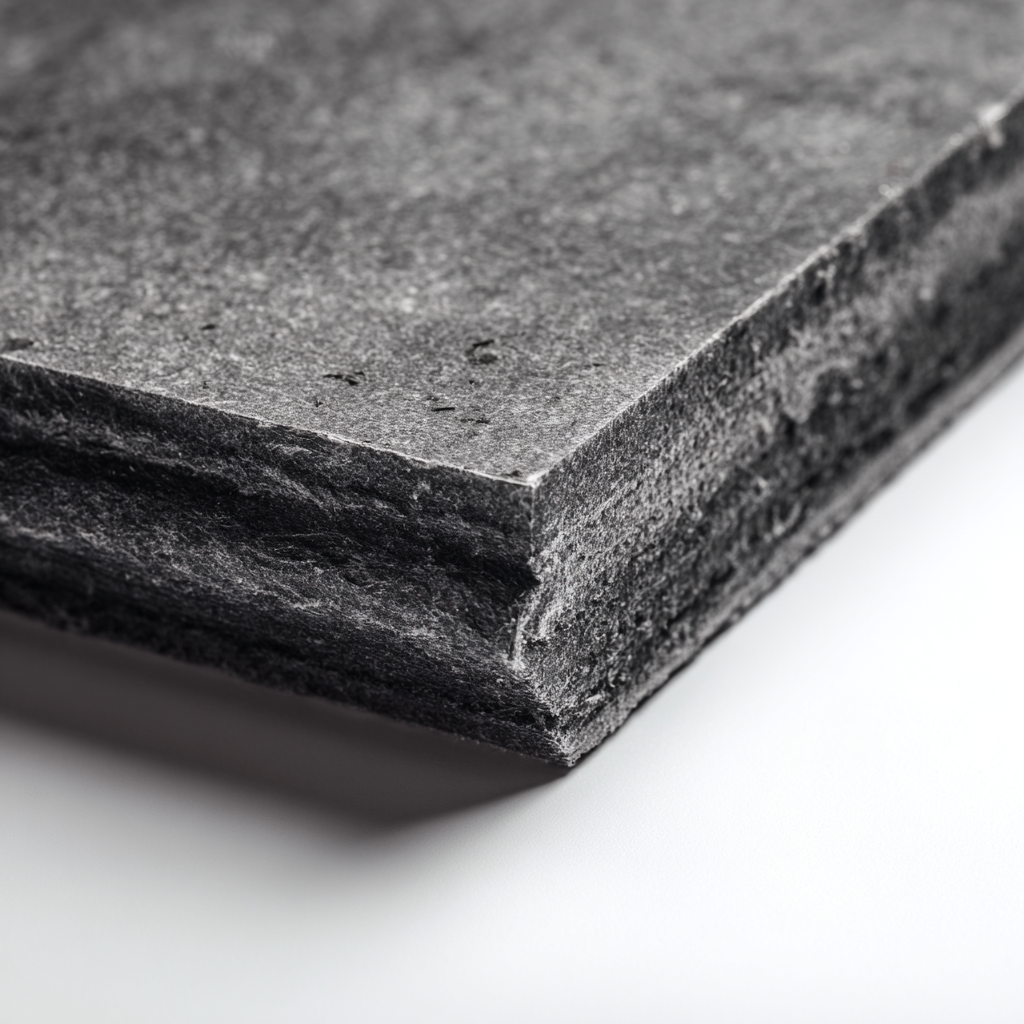
- 15 cm MGO insulated panels: fire-resistant, rot-proof, termite-proof and humidity-resistant
- Roof
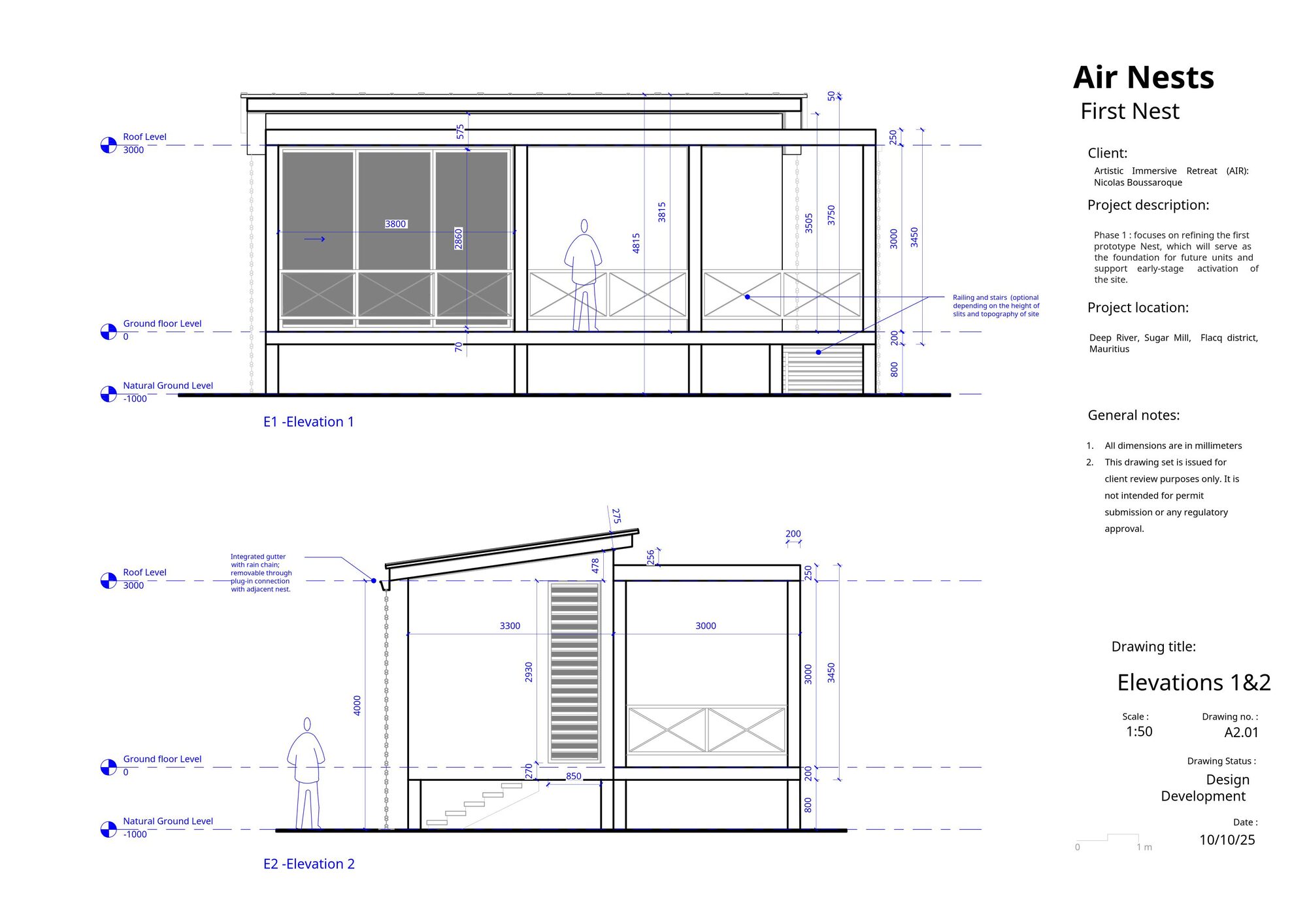
- Insulated mono-pitch at 8°, integrated gutters and rain chains
- Foundations
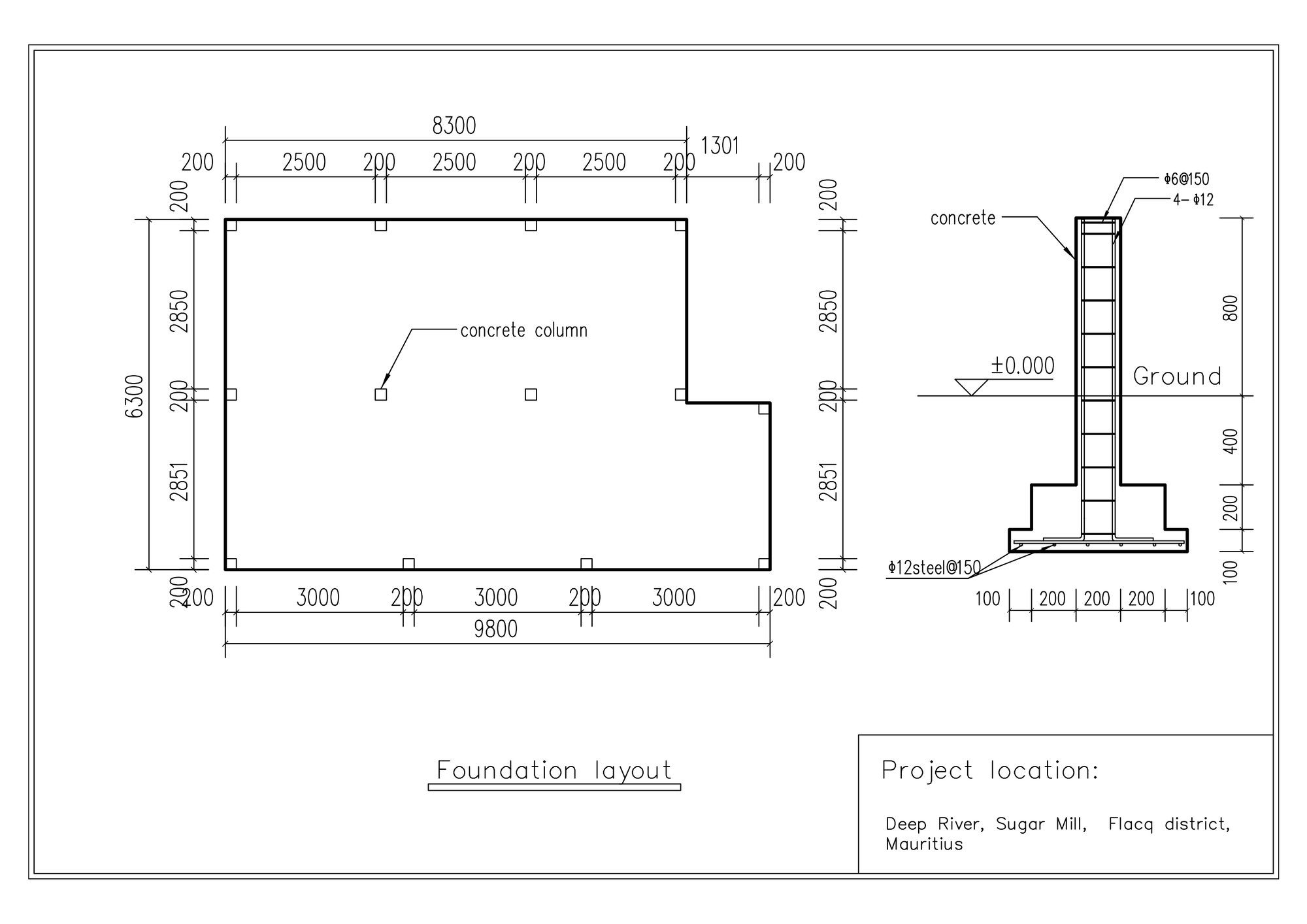
- Raised reinforced-concrete pads, minimal ground contact, good airflow
- Openings
- Double-glazed aluminium, mosquito screens on every opening
Climate as an ally
Indoor comfort comes with very little energy: MGO panel insulation, the veranda as a thermal buffer, cross-ventilation through aligned openings. Warm air escapes beneath the mono-pitch roof; cool air enters through the lower openings. The roof is reserved for future solar panels.
Touching the ground at a few points
Each Nest rests on small reinforced-concrete pads rather than a slab. The system preserves the topography, avoids heavy earthworks and keeps the ground permeable. The foundations are reversible: a Nest can be moved without leaving a scar.
Autonomous systems
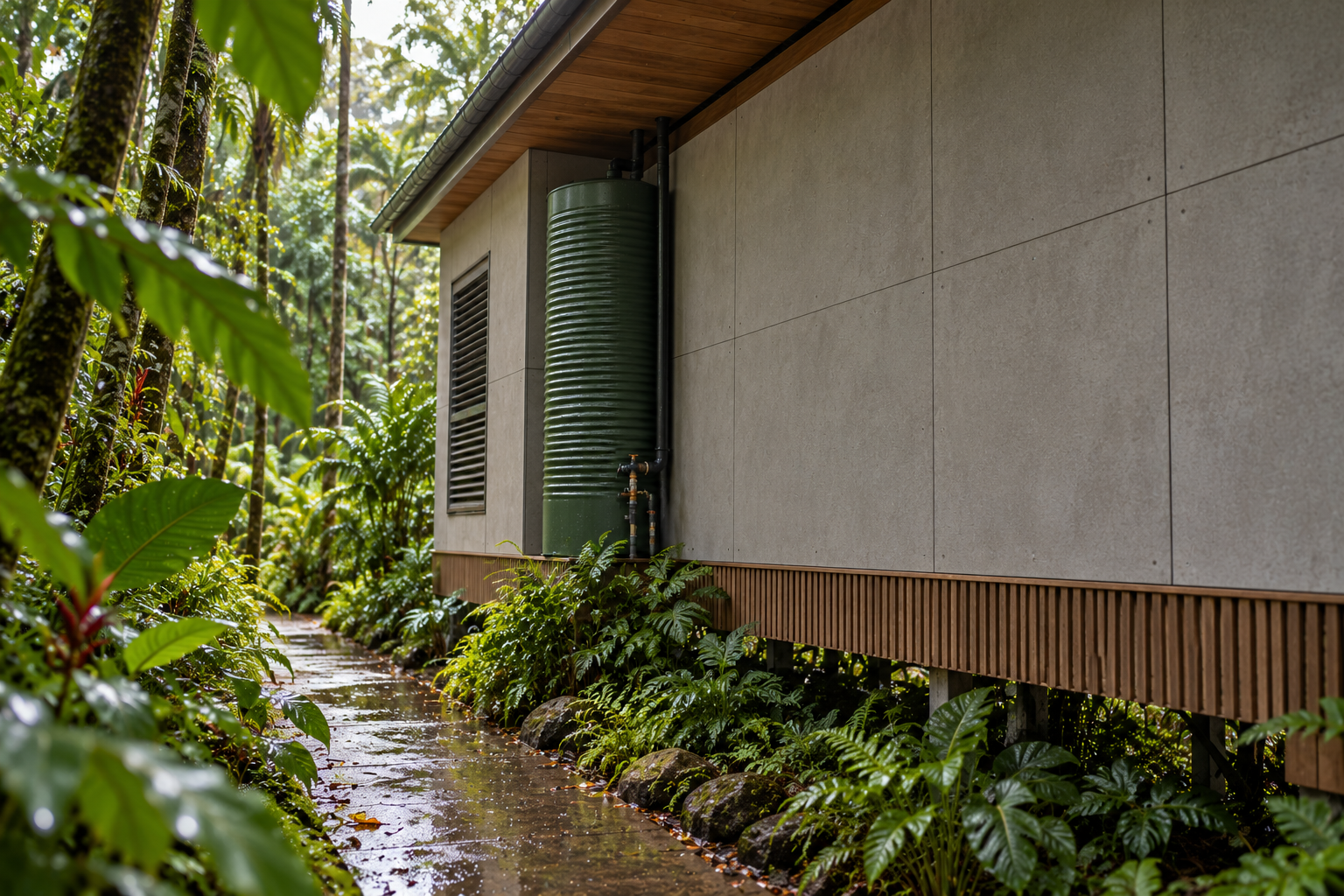
- Rainwater
- Roof, gutter, chains, then a 1,200-litre tank: five to seven days of autonomy for two guests
- Electricity
- Grid-connected, pre-wired for solar
- Greywater
- A treatment unit for each Nest
- Sanitation
- Individual septic system
Price and market
A price set on execution plans
Rs 2,700,000
Standard Nest, delivered and installed turnkey.
What the price includes
Full galvanised steel frame; 15 cm MGO composite walls and insulation; double-glazed aluminium openings; interior finishes (floors, paint, fixtures); installed kitchenette; complete bathroom; veranda and stairs; electrical and plumbing networks; air-conditioning pre-installation; individual septic system; transport, crane assembly, foundation pads and commissioning.
That is about Rs 50,700 per square metre, veranda included, for a dwelling delivered ready to host guests, whereas transport, foundations, sanitation and commissioning usually come on top of a construction price.
The market
| Benchmark | Occupancy | Average nightly rate | Source |
|---|---|---|---|
| Short-term rentals, Mauritius (median, 5,198 listings) | 63% | Rs 4,682 | Airbtics, Sep 2025 – Aug 20263 |
| Short-term rentals, Flacq district (243 listings) | 54% | US$206 | AirDNA, 12 months to Oct 20264 |
| AIR Nest, base assumption | 30% | Rs 7,000 | This document |
These assumptions are deliberately cautious: they serve to validate the model. The occupancy assumed is barely more than half that of the Flacq district; the rate, below that district’s average, is meant to rise with the venue’s reputation. It is per night and per Nest, not per person. Artist residencies, funded by third parties, are charged the same rate: they do not dilute income.
A Nest’s value lies neither in its floor area nor in luxury amenities: it lies in access to a living art venue, which drives word of mouth and loyalty beyond platform algorithms.
Nest+: two articulated Nests
The standard Nest is designed with an offset on the kitchen side that lets it connect to a second module, the equivalent of a Nest, built to fit against it. Together they host four to six people, families or longer residencies; the pair stays within each pitch’s allocated envelope, typically 250 to 400 m²; it is approved by AIR and the architect.
| Configuration | Investment | Nightly rate |
|---|---|---|
| Standard Nest | Rs 2,700,000 | Rs 7,000 – 10,000 |
| Nest+ | from Rs 5,000,000 | Rs 12,000 – 16,000 |
The second module is designed around its use: bedroom, studio, workspace. It shares the kitchen and wastewater system of the first; each keeps its own bathroom. The price shown is a starting point: the final quote follows the chosen layout. Returns follow the same logic as the standard Nest.
Operations
Full management, clear fees
The owner owns the Nest; AIR maintains the site and, if the owner wishes, manages the stays. Two separate items, known in advance.
What the owner pays
- Site fee
Rs 3,750 a month - Payable by every owner: maintenance of access and shared areas, site security, waste management, water and electricity networks. Rs 45,000 a year.
- Rental formula
Rs 5,830 a month - For Nests entrusted to AIR: the site fee plus landscape care of the pitch and priority response, so that every stay finds the Nest and its surroundings impeccable. Rs 70,000 a year.
Water and electricity consumption, read from individual meters, is paid by the owner: about Rs 2,500 a month, Rs 2,000 for electricity and Rs 500 for water. On top of this come Rs 40,000 to 60,000 of annual costs specific to the Nest: structural maintenance (15,000 to 20,000), cyclone and liability insurance (10,000 to 15,000), technical equipment: filters, pump, septic tank (5,000 to 10,000), contingency reserve (10,000 to 15,000).
Rental management: 70% to the owner, 30% to AIR
Owners who entrust their Nest to AIR keep 70% of rental revenue. AIR’s 30% covers full management and what no manager can offer: access to the gallery, the residencies and the programme, which supports the rate and drives occupancy.
- Guest handling
- Check-in and check-out, communication, issue resolution, concierge
- Programme
- Events, meetings with residents, experiences on site
- Revenue
- Pricing, market monitoring, seasonal strategy
- Distribution
- Photography, copywriting, listings, social media, partner platforms
- Overheads
- Staff, coordination, systems, internet
No guest-handling fee is charged on top. Cleaning and linen are paid by the guest, with the booking.
Projections
A cautious scenario, then what can exceed it
The base scenario assumes 110 nights a year (30% occupancy) at Rs 7,000 a night, with no rate increase and no capital gain on resale.
| Rental revenue (110 nights × Rs 7,000) | Rs 770,000 |
| Owner’s share (70%) | Rs 539,000 |
| Rental formula | – Rs 70,000 |
| Water and electricity consumption | – Rs 30,000 |
| Nest-specific costs | – Rs 40,000 to 60,000 |
| Owner’s net income | Rs 379,000 – 399,000 |
| Cash-on-cash return (Rs 2.7 M) | 14.0 – 14.8% |
At constant income, the outlay is recovered in about seven years.
Sensitivity to occupancy
| Nights a year, at Rs 7,000 | Revenue | Owner’s share | Owner net |
|---|---|---|---|
| 80 (22%) | 560,000 | 392,000 | 232,000 – 252,000 |
| 110 (30%), base | 770,000 | 539,000 | 379,000 – 399,000 |
| 160 (44%) | 1,120,000 | 784,000 | 624,000 – 644,000 |
| 180 (49%) | 1,260,000 | 882,000 | 722,000 – 742,000 |
| 200 (55%) | 1,400,000 | 980,000 | 820,000 – 840,000 |
Even at 200 nights, occupancy stays at the Flacq district level. A rate increase, toward Rs 8,500 to 10,000, is built in nowhere; it would be additional upside.
Over ten years, the internal rate of return is 14 to 15% in the base scenario, with the Nest resold at its purchase price. During ramp-up it reaches about 16% even if the Nest is never resold. Detailed scenarios and stress tests are in the investor file.
No capital gain is assumed. Projections rest on assumptions and do not guarantee future results.
Ownership
An asset of your own, on a site cared for
Each Nest is movable property, fully owned by its owner. It stands on a pitch at the Deep River site, which AIR operates.
The land belongs to Alteo, a Mauritian group listed on the Stock Exchange of Mauritius, which leases it under a ten-year renewable lease. AIR operates the site; it signs with each owner a pitch agreement matching the lease term, together with an optional rental management mandate. The full contractual chain is set out in the investor file.
Movable-property status may allow accelerated depreciation and avoids the constraints of permanent real estate. The exact tax treatment should be confirmed with each investor’s adviser.
If the lease were not renewed
AIR intends to open other sites; at expiry, it would offer a new pitch in its network. Owners may also choose to take back their Nest: the pad foundations allow it to be dismantled and reinstalled elsewhere. Transfer conditions and transport costs are set out in the pitch agreement.
Staying in your own Nest
Each owner may use their Nest in any season, through AIR’s internal calendar, with 60 to 90 days' notice recommended. Owners get priority on shoulder-season dates (April and May, September and October). The projections in this brochure assume four to six weeks of personal use a year; owners may stay longer, each personal night being a night taken out of the rental calendar. A personal stay incurs no guest-handling fee; the rental formula still applies. Exclusive personal use, outside the rental programme, remains a privilege: it is limited to two Nests out of twelve, subject to AIR’s approval and to a specific annual fee.
Resell, relocate, extend
- Resale
- At any time, to a private buyer or an investor; the buyer takes over the pitch and its agreement; AIR approves the buyer and holds no right of first refusal.
- Relocation
- To another AIR-approved site, in Mauritius or elsewhere, after a minimum anchoring period on site, counted from commissioning and set in the pitch agreement
- Extension
- Adding the Nest+ second module
- Full exit
- Transfer by movable-property bill of sale, with no land registry formalities; typically 30 to 60 days
AIR connects sellers with verified buyers and provides the rental history to support pricing.
Permits
In Mauritius, accommodation let to travellers must hold a certificate issued by the Tourism Authority, the Tourist Accommodation Certificate5. AIR handles this for each Nest, as it does all the site’s permits.
Before committing, every investor should carry out their own financial and legal analysis with advisers familiar with Mauritian law. Estimated returns are not a guarantee.
AIR today
A venue already alive, a team in place
The gallery and garden, officially inaugurated on 31 October 2026, welcome the public every day; exhibitions change roughly every three months.
Next will come workshops led by invited artists and artisans, a restaurant at the heart of the site, an art café in Flic-en-Flac and exhibitions shared with the Centre d’Art de la Pointe Tamarin. The show Nest, ready to be built, will be installed in early 2027.
The founders
Erwin Angeline, known as AirWind
Art direction
Mauritian visual artist active on the national and regional scenes, founder of Airwind Arts, a collective producing exhibitions, performances and artistic activations. He has curated group shows, workshops and multidisciplinary installations.
At AIR he leads the curatorial line, the residencies, the programme and the aesthetic identity of the Nests.
Nicolas Boussaroque
Strategy, development and operations
More than twenty years leading multidisciplinary projects across art, technology, hospitality and sustainability; proven practice in business modelling, operational design and partnerships; close knowledge of Mauritius.
At AIR he drives strategy, development, partnerships and site operations.
What AIR already builds on
- Airwind Arts
- The collective led by Erwin produces exhibitions, performances and events across Mauritius. It gives AIR a network of artists and continuous programming capacity.
- AIR Hospitality, Aanari, Flic-en-Flac
- A first hospitality experience under the AIR banner, in a seaside hotel: artistic experiences offered to guests of Aanari Hotel & Spa. Watch the video
- The architects
- Divyaa Hauzaree (DEA) designed the Nests and the site plan; Harikesh Sunkur, an architect, advises AIR on permits.
- The manufacturer
- Housinnovation, a modular construction specialist, builds the Nests.

Invest
Becoming a founding owner
Timeline
| 31 October 2026 | Official inauguration of AIR at Deep River |
| Early 2027 | Installation of the show Nest |
| 2027 | Five Nests open to order, installed in succession |
| 2028 | Six more Nests, twelve in total on the site |
From order to installation, allow about three months:
- Customisation, one to two weeks: materials, adaptations to use.
- Final plans with the architect, one to two weeks: validation and siting.
- Manufacture, four to five weeks.
- Site preparation, two to three weeks in parallel: pads, utilities, septic, greywater.
- Delivery and installation, five to seven days.
- Commissioning, one to two weeks.
Founding owners' benefits
Founding owners are the buyers of the five first-phase Nests, open to order in 2027.
- Choice of pitch
- River-facing or garden-facing, before the general offering
- Price lock
- Rs 2.7 M fixed for founding owners; an increase to Rs 2.9 M or more expected for the next phase
- Rental formula discount
- 15% for life, saving Rs 10,500 a year
- Visits
- Site visits from today; inspection of the show Nest once installed
Next steps
- Visit. The gallery, the garden, the pitches.
- Analysis. The investor file, on request: financial model, scenarios, risks and legal documentation.
- Reservation. Rs 300,000, whatever the model: the pitch is chosen and the price is locked. Refund conditions are set out in the reservation agreement.
- Staged payments. The rest of the price is called as the work progresses, up to handover.
| Stage | Share | Amount |
|---|---|---|
| Reservation | flat | Rs 300,000 |
| Start of manufacture | 40% | Rs 1,080,000 |
| Delivery on site | 40% | Rs 1,080,000 |
| Handover | balance | Rs 240,000 |
| Total | Rs 2,700,000 |
Investment: Rs 2,700,000 for a standard Nest, from Rs 5,000,000 for a Nest+. First phase: five Nests open to order, around the show Nest.
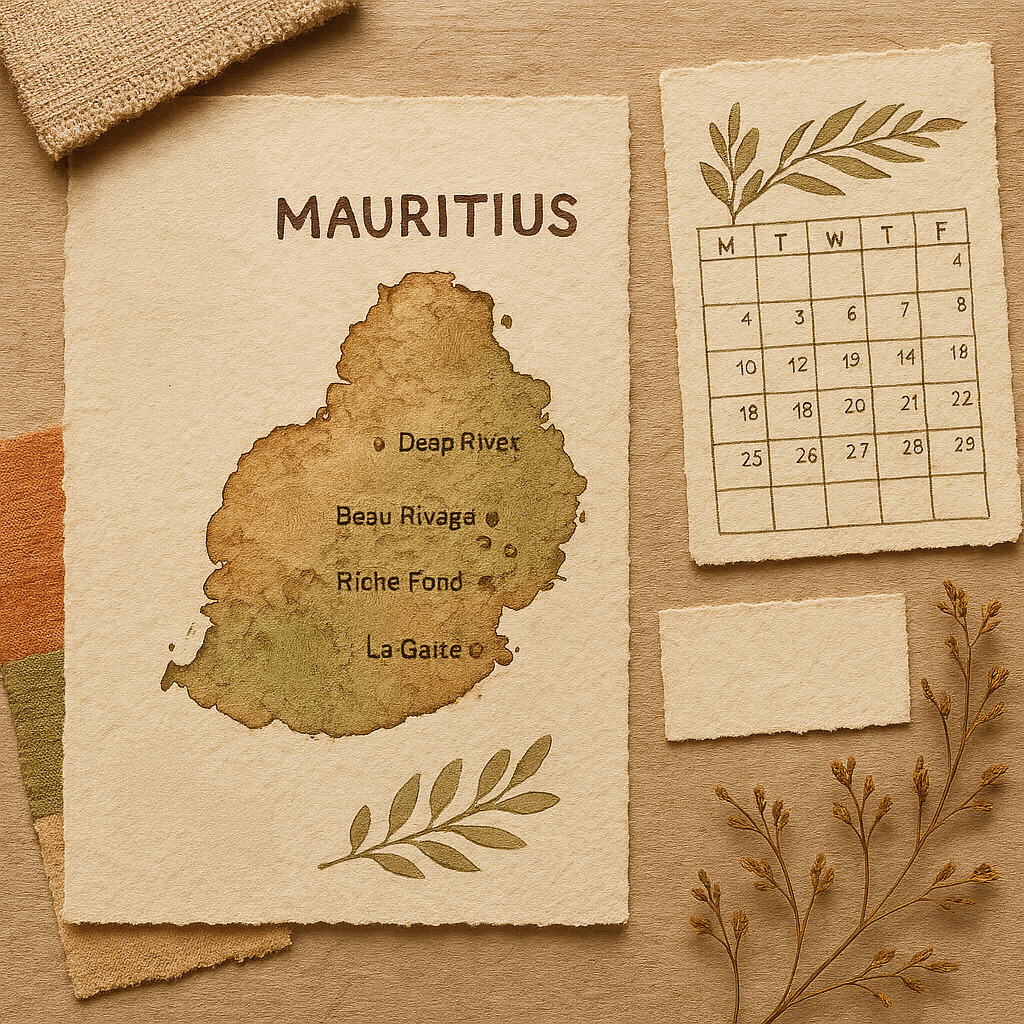
Beyond Deep River
In time, AIR envisages a network of places sharing the same identity. These sites are under study.
- Beau Rivage
- At the estuary where the Grande Rivière Sud-Est meets the ocean
- Riche Fond
- Inland: two vast pools on the river, one of them a natural swimming pool; a former mill
- La Gaité
- Countryside, agricultural arts programme
Visit
AIR, Artistic Immersive Retreat
Deep River, Flacq, Mauritius
Gallery and garden open every day
Sources
- ATTA, citing the Mauritius Ministry of Tourism, 2025 tourist arrivals, January 2026. atta.travel
- TIME Africa, interview with Richard Duval, Minister of Tourism, July 2026. africa.time.com
- Airbtics, Airbnb revenue in Mauritius, September 2025 to August 2026. airbtics.com
- AirDNA, short-term rental data for the Flacq district, updated 20 October 2026. airdna.co
- Westimmo, tourism licences in Mauritius, September 2026. real-estate-mauritius.mu
Questions
The questions we are asked
- Am I buying the land?
- No. You buy the Nest, movable property that you fully own; it stands on a pitch AIR rents to you, on Alteo land held under a ten-year renewable lease.
- What if the lease is not renewed?
- AIR offers you a pitch on another site in its network; you may also take back your Nest, which its pad foundations allow to be dismantled. The terms are set out in the pitch agreement.
- Who pays for repairs after a cyclone?
- The structure is covered by the manufacturer’s ten-year guarantee. Each owner also takes out cyclone and liability insurance, included in the annual costs.
- Can I resell quickly?
- Yes, at any time, by movable-property bill of sale, typically within 30 to 60 days. AIR connects sellers and buyers and approves whoever takes over the pitch.
- Who sets the nightly rate?
- AIR, as part of rental management. The model assumes Rs 7,000 a night, a deliberately cautious rate.
- Do artist residencies reduce my income?
- No. They are funded by third parties and charged the same rate as a stay.
- Can I stay in my Nest?
- Yes, in any season and with no guest-handling fee. The projections shown here assume four to six weeks a year; longer use remains possible, at the cost of the nights taken out of the rental calendar.
- Do I have to rent out my Nest?
- Exclusive personal use is possible for two Nests out of twelve at most, with AIR’s approval and against a specific fee.